Tuesday, November 28, 2023

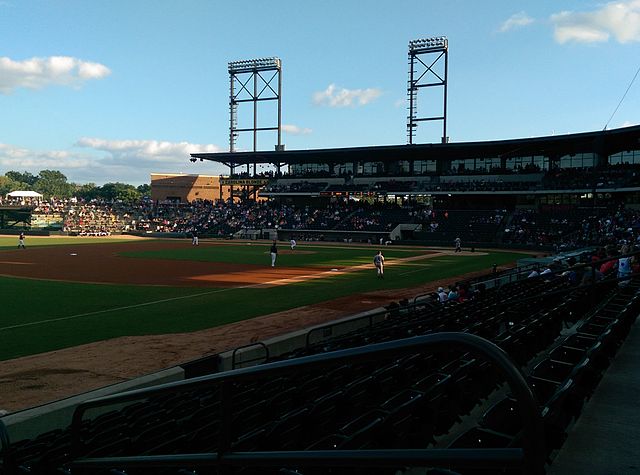
Washington Nationals, Nationals Park

By AgnosticPreachersKid (CC 4.0)

SATURDAY, JULY 22: The Washington Nationals downed the San Francisco Giants, 10-1, at Nationals Park in Southeast Washington. Angela and I were there, lower deck, first base side. Josiah Gray pitched seven strong innings to record the win for the Nats, and shortstop C.J. Abrams contributed a home run.

We made this trip mostly to cap off our Year of Live Baseball, to mark the end of our tour of minor league ballparks with a visit to The Show. Angela gave me the choice of city and team. I asked to go to Washington and see the Nats, feeling that it was a loose end that needed tying up. My years as a Little League player and my early years as a fan were spent in the Virginia suburbs of Washington - Vienna, to be exact. But my family's arrival in the D.C. area coincided exactly with the demise of Washington's major league team, the Senators, who decamped to become the Texas Rangers. I became a fan of the Baltimore Orioles, just up the road, which was no hardship (the Orioles were consistently strong in the 1970s). But it would have been nice to have a baseball team in the District to root for. And I had never been to a Nationals game since their arrival in 2005. And I was overdue for a visit to Washington, a city I have a lot of love and nostalgia for.

The Nationals were born in 1969 as the Montreal Expos. Over 30-odd seasons, the Expos boasted some elite playing talent: Gary Carter, Andre Dawson, Tim Raines, Vladimir Guerrero. But they were also burdened with home parks that were ill-suited to major league baseball (Jarry Park might've been fine for the minors; Olympic Stadium was miserable for any purpose) and a shaky financial base overall. 

Meanwhile, however you might feel about it, Metro D.C. boomed between 1971 and 2005, in both raw population and disposable dollars. After multiple rumors over the years of the Expos' leaving Montreal and of Washington getting a new team, when the news broke that the Expos were heading to D.C., it seemed okay, with a whiff of inevitability. Unlike most franchise moves, I didn't hate this one.

The new Washington club would not keep the name Expos (or the garish uniforms; I'm not sure they ever throw back for those). But they would also not revive the name Senators. Notwithstanding the Hall of Fame pitching career of Walter Johnson, culminating in one World Series victory in 1924, the Senators had often been a punchline: "First in war, first in peace, last in the American League." Plus, the actual United States Senate had seen its reputation suffer. Nationals or Nats had been the informal alt-identity of the Senators. To combine it with the classic script lettering of the latter-day Senators of  the '60s -- that's pretty good branding, in my book.

The Nationals built the quality of the team gradually, first through the draft and farm system, then a burst of free-agent spending, which paid off in 2019 with a World Series title. Frustratingly, however, this success could not be sustained: the Nats couldn't meet the salary requirements to keep most of its best players. (Sadly, in August, we learned that Nats pitcher Stephen Strasburg is retiring at age 35. Strasburg led the team to glory in 2019 but has barely pitched since then due to nerve damage in his elbow. He was the one player the front office signed to a max contract.)

In the alternating boom-and-bust manner of many U.S sports franchises now, the Nationals now rely on young, cheap talent. Take the two young stars of the 7/22 game for the Nats. Josiah Gray was the Nats' representative on the All-Star team this year. C.J. Abrams was having a Bobblehead Day the day we were at the park. Crucially, each of them is on a bargain salary, in the $700,000 neighborhood. When the Nats mature and become contenders again, will the financial will be there to make another run? Flags fly forever, it is said, but do earnings reports know the meaning of forever?

Anyway, it was a nice weekend. In a novel move for us, we rode Amtrak from Raleigh to Washington's Union Station. Our hotel was a walkable distance from the ballpark, and close to a Metro rail station. So it was a car-free weekend, and our Saturday jaunts (to the Smithsonian and to visit a friend in far NW D.C.) were easily manageable via Metro. 

Nationals Field, which debuted in 2008, gets high marks. I'm in the bag for any newish ballpark with a grass playing surface and bars and restaurants within walking distance. Much of Southeast Washington near the Anacostia River is newly developed; I have no childhood memory of this part of the city, because no tourists would linger there in those years. The park's playing dimensions are pretty symmetrical and not unusual. The designers did throw in a funny angle in the outfield fence in center field, just for the sake of local color.

We ignored the city's fine-dining scene on this visit; hopefully we can rectify this oversight next time. However, I've been hearing about Ben's Chili Bowl for many years, and thought I'd like to try it... Maybe it's cheating, but when I learned Ben's has a stand at Nationals Park, I figured I would check off that box at the game. The half-smoke with chili, falling apart in my hands, was good. 

Side note about the game and my sense of mortality: As a kid playing Little League ball in Vienna, I owned a Carl Yastrzemski autograph model fielder's glove. The Giants' starting left fielder in this game was Michael Yastrzemski, who is (get this) Carl's grandson. His 32-year-old grandson, at that. 

Historically, Washington produced quite a few notable players and other figures in the baseball industry, especially in the early decades of professionalism. 

  • Although biographical details are scant, several Black Washingtonians made an impact in Negro League baseball, including Nip Winters and Script Lee, who both pitched for the Hilldale Club in the Eastern Colored League during the 1920s.
  • Art Devlin (1879-1948) was a two-sport star at Georgetown, then played third base for John McGraw's New York Giants from 1904 to 1911. He was a brawling, hustling Irishman of the type McGraw liked. He played with three pennant winners in New York. 
  • Doc White (1879-1968), also a Georgetown man, was a quality left-handed pitcher, winning 189 big league games. He earned his nickname because he was a practicing dentist for a time. Doc pitched for the Hitless Wonders, the 1906 Chicago White Sox, and got a save and a win over the crosstown Cubs in the two concluding games of the World Series that year.
  • Lu Blue (1897-1958) - An interesting name for an interesting player. Lu was a switch-hitting first baseman without home run power but with a great ability to get on base. He came up with the Detroit Tigers in 1921 during a meh period for the club, the latter Ty Cobb years. Lu subsequently played for the St. Louis Browns and the White Sox, and was a regular for 12 years all told. He grew up in DC and returned to the area in his post-playing years. 
  • George McQuinn (1910-1970), an Arlington, VA native, was a line drive hitter and a slick-fielding first baseman. He spent most of his big-league career with the mostly bad St. Louis Browns, but capped his career as the regular 1B on the World Series champion Yankees of 1947.
  • Maury Wills (1932-2022) was the Los Angeles Dodgers' shortstop for their brilliant early-1960s run. He won two Gold Gloves and in 1962 set a single-season MLB record by stealing 104 bases. He played in four World Series and was on the winning side in three (1959, 1963, 1965). Maury graduated from Cardozo High School, not far from Nationals Park in the District.


Thursday, September 28, 2023

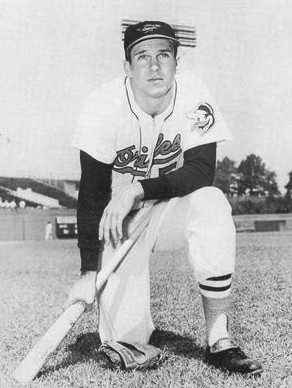
Brooks Robinson


Baseball great Brooks Robinson passed away on September 26th, aged 86. He was at the heart of the Baltimore Orioles teams that I loved in the 1970s, a fixture at third base, a 16-time Gold Glove winner. He remained around the team even after retirement, and became a favorite adopted son of the city of Baltimore. Brooks's national profile went way up in after his MVP performance in the 1970 World Series, with the fielding gems he crafted and which have lived on in highlight reels ever since. I think of him first as a sweet-natured down-to-earth guy. From memory I can easily cue up the sound of his voice, that high pitched Arkansas accent, from local commercials and post-game interviews. Brooks had a Walter Mitty quality, giving hope to the balding, slope-shouldered anti-phenoms of the world. He epitomized the saying that an athlete is one thing, a baseball player is something else. 

I've been looking over his numbers, and at what Bill James wrote about him in the Historical Abstract. It's possible, in light of latter-day analytics, that we (Oriole fans and others of his contemporaries) overrated Brooks somewhat: that the dazzling defensive highlight reel outshone his offensive abilities, which were good but not dazzling. He was possibly the greatest fielding third baseman who ever played. But overall, Bill James has him at number 7 on the all-time 3B rankings, and he's probably fallen a notch or two since that list was published in 2001. There were years in the heart of his career where Brooks was an average hitter, or a little worse.

Brooks led the league twice in GIDP, which is evidence that he was a slow runner. But also, he led the league four times in Sacrifice Flies (and wow, there are a lot of ex-Orioles near the top of this list). He didn't strike out much, which speaks to good strike zone judgment and bat control. He didn't have brute batting power, but I'd say he had the timing and mechanics needed to ride the ball a long way. Given Brooks's obvious defensive skill set, gained through hard work and practice and study of the game, it makes sense to me to think of his offensive skill set this way. In his career, Brooks hit 268 home runs and 114 sacrifice flies. Robin Yount is the only player with fewer HR's and more SF's (251 and 123). 

I had a memory that turns out to be apocryphal: Brooks had a sporting-goods business that got into trouble, at or near the end of his playing career. In my mind, Baltimore fans had spontaneously come forward and donated cash to help Brooks stave off bankruptcy. According to Wikipedia, this was an exaggeration (though there was public concern that Brooks would lose his house). Wikipedia also contains an anecdote that in 1976, when Earl Weaver told Brooks he was being benched in favor of young Doug DeCinces (a handsome, broad-shouldered phenom of the classic type), Brooks asked the Orioles to explore the possibility of trading him. The Chicago White Sox were interested, but would not extend Brooks's contract beyond that season. So Brooks vetoed the deal. Late in the 1977 season Brooks retired, having never worn a big-league uniform other than Baltimore's.


Photo: Jay Publishing via tradingcarddb.com, Public domain, via Wikimedia Commons

Tuesday, April 25, 2023

The Captain


Basketball Hall of Famer and two-time NBA Finals MVP Willis Reed died on March 21. 

The word "iconic" is overused, in my opinion. But it's hard to avoid it when talking about the 1970 New York Knicks, or Madison Square Garden, or "the Willis Reed Game." 

May 8, 1970 was the day of Game 7 of the NBA Finals, Los Angeles at New York. The atmosphere was heavy with anxious speculation, since Reed had suffered a bad thigh injury a few days earlier. He couldn't possibly play. Could he?

When Reed emerged from the locker room, in uniform, and limped onto the court for warm-ups, the Garden exploded in cheers. Just by showing up for duty, the Knick captain had galvanized the home crowd and transformed doomy angst into a great hope. After tip-off, on the first possession, Reed sank a jump shot. The Garden was enraptured. Second trip downcourt, same thing. By then the Knicks were flying and the Lakers were chained to the floor. Those four points were all Reed would manage, but Walt Frazier would supply 36, and the rout was on. The Knicks built a 27-point halftime lead, and cruised to the franchise's first championship.  

Ray Ratto's obituary at Defector was headlined "Willis Reed Met The Moment."

It’s as big as it is, even still, because Reed always seemed content to let it be what it was; the legend spread as legends used to, by word of mouth and images of his two jumpshots. Reed himself never really said much about it, and he didn't have to. He did the perfect thing at the perfect time when everyone was looking, and then let it speak for itself. The lasting moments are like that.
In 1971 Reed's body seriously started to break down, in a cascading series of leg injuries. This is how I remember him, as a wounded warrior, struggling bravely to summon a ghost of his former self. In this diminished state he helped the Knicks to a second NBA title in 1973.

Writing in the afterglow of the Willis Reed Game, Pete Axthelm lauded Willis as a unifying figure between downtown and uptown, between the glamorous Knicks and the grassroots basketball culture of Harlem and the outer boroughs. Reed pioneered a new style of leadership and of masculinity, in Axthelm's view. This seems a little too grandiose now. A few years later his Knick teammate Bill Bradley wrote more simply that Reed was "the dominant member... the perfect center for our team that year." 

Reed was named to the NBA's 50th and 75th anniversary teams. His career numbers are not in the same stratus as those of the very greatest centers: Russell, Chamberlain, Kareem, or Shaq. (Russell loved Willis's game, however, and Willis and the young Kareem had some phenomenal head-to-head battles in the 69-70 season, recounted by Axthelm.) Willis was a fine versatile player, a great team player, the captain of a two-time champion, an honored part of a great hoops ensemble. 

Willis was named the Finals MVP in both '70 and '73. In neither year is it obvious from the stats sheet that he was the best player in the series. Notably, in both years, the Knicks vanquished the Lakers, featuring Wilt Chamberlain as Willis's opposite number. One could call these awards to Willis a roundabout compliment to Wilt - if you beat The Man, you must be the man - but it's also a comment on each man's style of play and character. Wilt was a monumental talent but a confounding human being. Wilt's teammates always had to fit themselves around Wilt. Whereas Willis fit himself within the team, and met the moments as they came. Willis would lean on Wilt in the post, draw him away from the basket with the threat of his jump shot, act as a decoy. He didn't thrash Wilt, he outfoxed Wilt. Bill Russell is often remembered as Wilt's great foil, but Willis, even on one good leg, had his own anti-Wilt mojo. 


Friday, September 30, 2022

Charlotte Knights, Truist Stadium

Our 2022 baseball quest has reached its end. The Nashville Sounds cruised to an easy 9-1 win over the Charlotte Knights, Friday, September 9. I guess a quest is not supposed to end with the Knights losing, but I am celebrating nonetheless. Whew! 

If it isn't obvious, Angela and I chose which games to attend based on scheduling needs, not baseball criteria. The outcome of this game might have been expected, considering Nashville is in first place in their division of the International League, and Charlotte is in last place in its division. 

This year's Knights team is Class AAA's Island of Misfit Toys. Their best player is a 30-year-old, short, stocky guy churning around center field. Their right fielder looks like Adonis but strikes out too much and doesn't hustle. Their corpulent first baseman is a failed catcher. The best athletes are not good enough players, and vice versa. Maybe the White Sox will deal them a better hand next season.

What can I say about the city of Charlotte that it hasn't already said about itself? It is North Carolina's largest city, and it has the traffic and the steel-and-glass towers to go with that status. The place has grown and changed determinedly in my lifetime. In the 1980s and 90s, Charlotte elbowed its way from being a regional banking center to a national one. In the same time frame, it became a major league pro sports city, landing teams in the NBA and NFL. (Raleigh acquired an NHL hockey team, but it's a consolation prize.)

The rest of the state has a complex about Charlotte: the eldest, most successful sibling that the others have tepidly loyal but slightly resentful feelings toward. A series of politicians has thought that being mayor of Charlotte would be a springboard to higher political office, like Governor or Senator. Most of them have been disappointed. Rural voters don't like city pols in general, and voters in the other North Carolina cities just don't especially like Charlotte.

Despite its strong minor league history, North Carolina has never had an MLB team. It took some doing just to get Charlotte elevated to Class AAA status in 1993. But Charlotte has had a minor-league team almost continuously since 1901. 

The team was called the Hornets for many years. There is a disputed story about a 1775 Mecklenburg Declaration of Independence. Whatever the authenticity of this document, it is true that a British official referred to Mecklenburg County as a "hornet's nest" of rebellious sentiment. Some Charlotte people take a lot of pride in this history, and adopted the Hornets nickname for their ball team. Of course, the Charlotte NBA franchise has now claimed that nickname. 

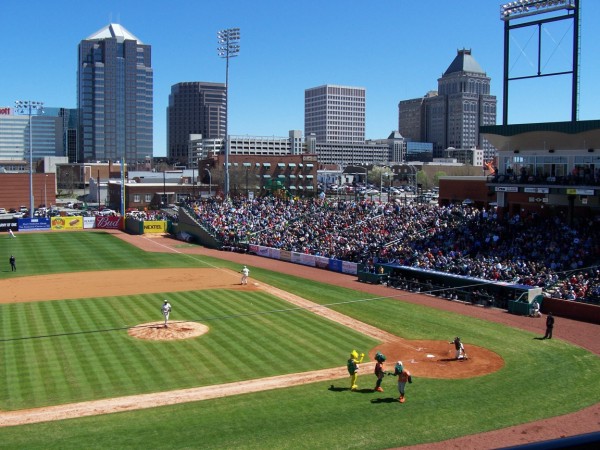
My circa-1985 memory is that Charlotte's ballpark was tired and shabby. Truist Stadium, opened in 2014, is pristine; Angela considers it the nicest ballpark we've visited, hands-down.  As McCormick Field is surrounded by trees, Truist is surrounded by skyscrapers. It's a nice view from inside. 

Photo by JBJ

This was a special night at the ballpark for the Catholic Diocese of Charlotte. A nun threw out the first pitch; a chorus of seminarians sang "Take Me Out to the Ball Game;" the bishop said a few words via the JumboTron. All unexpected, but nice. Ballpark foods consumed: Philly cheese steak (I had it in sandwich form, Angela in nachos form) that was sinfully good. Beer enjoyed: a Hop Drop 'N Roll IPA from NoDa Brewing Company in Charlotte.

Charlotte grew up with the Southern textile manufacturing industry after the Civil War. As a banking and railroad hub, it was first among equals relative to Gastonia, Concord, Albemarle, and others. At heart, though, in its earnest boosterism, Charlotte is a big small town, the biggest mill town of them all. 

  • Huntersville native Hoyt Wilhelm (1922-2002) broke into pro ball in 1942 with the Mooresville Moors, just a few miles from home. Class D ball, unaffiliated, the lowest rung of the ladder. He entered WW2 military service for three years, then spent two more seasons in Mooresville. Big-league teams consistently doubted him: he was a knuckleball pitcher, which was unfashionable, and he got a late start due to the war. Wilhelm was a surprise success as a 29-year-old rookie reliever with the New York Giants. He bounced from team to team. But he lasted until age 49 and was an All-Star as late as age 47. He set an MLB record by pitching in 1,070 games. Wilhelm entered the Baseball Hall of Fame in 1985, capping a remarkable, sprawling career.
  • Sonny Dixon (1924-2011) has a lot in common with Hoyt Wilhelm: He broke in with his hometown team, the Charlotte Hornets, and he was slow to fledge and leave the nest. He was a right-handed pitcher, a rubber-armed innings eater.  Like Wilhelm, he spent the years 1943-45 fighting WW2. He rose through the minors slowly. Unlike Wilhelm, he had the bad luck to wind up with weak parent organizations; he broke into the bigs with the Senators and then pitched for the Athletics (Philly and KC). His final MLB stint, three appearances, was with the 1956 Yankees. Dixon pitched for the Hornets again at ages 34-35 before hanging them up. He lived most of his life in the Steele Creek community near Charlotte, and is buried there. 
  • Minnie Mendoza (b. 1933 or 1934) was born and raised in Cuba, but is an honorary Charlottean thanks to spending 10 seasons with the Charlotte Hornets when they were a Senators/Twins farm team. He was sort of a full-time utility infielder, a Billy Goodman or Tony Taylor type, about the same quality. Why he spent so long at Class AA Charlotte, I don't know--possibly for his coach/mentor qualities. He finally got his cup of coffee in the Show with Minnesota in 1970, when he was 35 (maybe 36) years old.
  • Raised in the world of mill-town baseball, Tommy Helms (b. 1941) went on to be the regular second baseman on the 1970 Cincinnati Reds, who won the NL pennant. He was a 9-year MLB regular with the Reds then the Astros. A good glove man, he enabled Pete Rose to switch from 2B to right field. Tommy's nephew Wes Helms is an ex-major league player and formerly managed the Charlotte Knights.
  • Dickie Noles (b. 1956) was a journeyman pitcher, a reliever and spot starter. He spent 16 seasons in the pros, pretty evenly divided between the minors and the majors, mostly with the Phillies and Cubs systems. He earned a World Series ring with the 1980 Phillies. Noles and Ray Durham are both alums of Harding High School in Charlotte.
  • Ray Durham (b. 1971) came up with the Chicago White Sox and later played with the A's. Giants, and Brewers. He was damn good; I had him on fantasy teams a couple of years. He had some power, stole some bases, and drew walks. He was a plus fielder at second base, at least in his younger years. Durham was named an All-Star twice (1998 and 2000), had six years of over 100 runs scored, and had a long MLB career: 1975 games, 2054 hits.
  • Alex Wood (b. 1991) is a lefty power pitcher, currently with the San Francisco Giants. He pitched in three World Series with the Dodgers, winning a ring in 2020. He was an NL All-Star in 2017, amassing a 16-3 won-loss record. He has dealt with injuries off and on since high school, but he is mighty good when healthy.


Tuesday, September 13, 2022

Asheville Tourists, McCormick Field

In their final home game of 2022, the Asheville Tourists trounced the Bowling Green Hot Rods by a 16-6 score on Sunday evening, September 4. Gray skies and intermittent drizzles were not going to stop the game nor the postgame fireworks show. Angela and I were there along with our daughters Lily and Molly.

Our love affair with Asheville and its environs continues. I grow fonder of this city every time I visit, and I have my kids to thank. Two of them matriculated at UNC-Asheville and each then stuck around for a year or more after graduation. Hannah has since moved away, but Lily is still an AVL resident. This being Labor Day weekend, we made a nice 2 1/2 day visit of it. We selected a hotel in the Biltmore Village area, which I was unfamiliar with, and spent Saturday afternoon shopping and wandering that area. Saturday dinner was at Nine Mile on Montford Avenue. Sunday afternoon we took an excursion to Cherokee and the museum there, about an hour's drive west of Asheville. Then Sunday evening we went to the ballpark. 

McCormick Field was first built in 1924. It is tucked into a hillside in a neighborhood a mile south of downtown, near Mission Hospital. This is one of my favorites among the ballparks we've visited. The park was renovated in 1991-2, replacing wooden grandstands with brick and concrete. So McCormick combines character with modern comfort. The rows of seats rise at a steep angle, and there is plenty of leg room, which was my only mild criticism of Grainger Stadium in Kinston. It was a nearly full house, incidentally, full of high spirits, with a lot of families, some gray heads and many children and youth. 

Behind the outfield fence is a ring of trees. You can see the corner of a football field looking over from a plateau beyond left-center. The distance down the right-field line is only 297', partly mitigated by the 36-foot-high fence there. But center field is only 370' and right-center 320'. It sure seems like a great place to hit. 

McCormick had a wide selection of foods for sale (though execution varied somewhat) and a deep lineup of beers on tap. Ballpark beers enjoyed were both from Asheville: the French Broad River Kolsch, and the Hi-Wire Bed of Nails brown ale


Minor league baseball first emerged in Asheville around the turn of the 20th century. For a few years the team was nicknamed the Moonshiners, then the Mountaineers. In 1915, sportswriters began to refer to the team as the Tourists. This article claims that the nickname was simply due to most of the players being from somewhere other than Asheville. Anyway, the name has stuck; in spite of a couple of efforts to rename the team, it has always reverted to being the Tourists. It's one of the most enduring brands in the sport. 

I like Tourists; it fits. It may not inspire fear or awe; it may be pedestrian like Tars or Tobs or Furnituremakers. But Asheville is about people coming and going, exploring, exchanging, perhaps daydreaming a bit. Wikipedia says that the Cherokee used it as a meeting ground. Hernando de Soto noted the presence of a settlement here. People are attracted here by the natural beauty and outdoor recreation. Two rivers have their confluence in Asheville. It became a regional railroad hub. A scion of the Vanderbilts visited Asheville, was enchanted by it, built a big home here, and transformed the city and the region. There was manufacturing here, but it has also been a center of visual arts, architecture, and music. 

Asheville was home to a Black team (i.e. part of the Negro Leagues) for a couple of years in the 1940s, although I don't have much information on them. 

Asheville has been a fixture in the South Atlantic League since 1980. The movie Bull Durham wrote the Asheville Tourists into Crash Davis's story, and used McCormick Field as a shooting location. The area produced top players a century ago, and produces its share of top players today. 

  • Ham Hyatt (1884-1963) grew up in Candler and was recruited by his uncle to enter pro ball. He was an outfielder, and is identified by baseball historian Steve Treder as the first pinch-hitting specialist in the majors. This was with the 1909 Pittsburgh Pirates, who stormed to the National League pennant. Hyatt was summoned off the bench in the first inning of Game 7 of the World Series to replace an injured regular, and played well as the Pirates clinched the world title. Although mostly a reserve in the majors, he was a star in an 11-season minor league career.
  • Cliff Melton (1912-1986) broke into pro ball with the Asheville Tourists in 1931. He made a big splash in his major league debut season, 1937, winning 20 games and helping the New York Giants win the NL pennant. He battled arm trouble in later years, and wound up winning 86 games in the majors and 136 more in the minors. 
  • Ken Holcombe (1918-2010) grew up around Asheville. His father was a furniture and cabinet maker. Right after high school Holcombe pitched for a year in the King Cotton Textile League, for the Greenville, SC club. He played 17 years as a pro, had some good years in the high minors, and pitched 99 games in the majors, scattered over six seasons. When his playing days were over, he settled in Swannanoa, raised his family, and worked as a supervisor for Beacon Manufacturing, a textile firm specializing in blankets.
  • Sammy Stewart (1954-2018), from Swannanoa, was a colorful and effective utility pitcher for the Baltimore Orioles in the late 70s and early 80s. He allowed 0 earned runs in 12 postseason innings as an Oriole. 
  • Greg Holland (b. 1985) was active with the Texas Rangers until earlier this season. A pitcher, a right-handed closer, a three-time All-Star. Holland grew up in Marion, in McDowell County, and starred at Western Carolina University. He appeared in the 2014 World Series for the Kansas City Royals, who fell in seven games to Madison Bumgarner and the Giants.
  • Cameron Maybin (b. 1987): Born and raised in Asheville, Maybin was still an active player in 2021. A fast, rangy center fielder, he was a big-league regular for about four years, and a useful MLB sub for about 10 more. He played in 3 games as a defensive sub in the 2017 World Series, for the Houston Astros. 

Photos by JBJ

Thursday, September 01, 2022

Gastonia Honey Hunters, Caromont Health Stadium

SATURDAY, AUGUST 20: In Atlantic League of Professional Baseball action, the Gastonia Honey Hunters knocked off the visiting High Point Rockers, 11-5.

Photo by JBJ

As a repeat customer I feel qualified to say, ALPB baseball is a pretty good product. The Honey Hunters are strong this year; they will be competing in the championship playoffs in September. It seemed that every guy in their line-up is sporting an OPS in the 800 to 900 range. Possibly the 304-foot left field dimension contributes to that potent offense. The Honey Hunters jumped out to an early lead, then let the Rockers get back into the game in the middle innings, before putting the hammer down to extinguish the threat. 

We have a friend here in Raleigh who is a native of Gastonia, and she briefed us prior to our trip, enthusiastically, about things to see and do. We tried to follow her advice, failed in some cases. But our visit was animated by our friend's civic pride and hope. Most of us, certainly Angela and I, know the feeling of loving a small town, seeing the best in it, the untapped potential amid or alongside the decay. 

Gastonia has its challenges, as a former textile town, like so many towns in the Carolinas. (You're close to the South Carolina border here.) Something particular to Gastonia is that Loray Mills was the site of a famous strike and episodes of union-related violence. This is a complicated legacy. 

Renewal efforts are underway in Gastonia. Loray Village is a project to re-purpose the massive red-brick mill building into apartments, retail shops, and a museum. The Esquire, where we ate breakfast on Sunday, is a boutique hotel occupying a former bank building downtown. We had post-game drinks and nachos at Pita Wheel, which was a gas station in its former life. And the Honey Hunters ballclub, its stadium, and the FUSE District represent a broad-based plan to bring sports and entertainment to the area between Loray and the downtown center.  

Photo by Upstateherd (CC 3.0)

Caromont Health Stadium is a nice ballpark in only its second year of existence. It has the wall-to-wall carpet that High Point's home park has, which I dislike, but it's well-designed for multi-sport potential, with seating close to the action. We sat immediately behind the home team dugout, which added to the fun; we felt we were part of the players' conversations. 

Photo by Milbpics (CC 4.0)

Caromont has a friendly, efficient staff, including the EMTs who dressed Angela's wound after she fell and skinned her knee while crossing the street to enter the park. This was our first significant injury of the year, but Ange was a gamer and spectated through the whole contest. 

Ballpark foods consumed included a chili dog, Cracker Jacks, and a SunDrop soda. Local beer enjoyed: an Olde Mecklenburg Copper Altbier, out of Charlotte.

The crop of big-league ballplayers from around Gastonia is impressive. I was surprised. There are a bunch of All-Stars, 20-game winners, and MVP vote getters here. Gastonia is a bigger town than I tend to realize, for one thing.

  • Jake Early (1915-1985), from Kings Mountain, was a catcher and longtime teammate of Buddy Lewis's with the Washington Senators. After leaving the Senators, Early played several more years in the minors. He had stints as a manager in Rock Hill, SC and Statesville, NC, and appeared as a pitcher for the Gastonia Rippers in 1960, aged 45.
  • Buddy Lewis (1916-2011) was an outstanding player for the Washington Senators in a career shortened by WW2 military service. Lewis served in the U.S. Army Air Corps, flying supply missions over the Himalayas. He played third base, then later right field for the Senators. After retiring as a player, he returned to Gastonia and ran an auto dealership.
  • Whitey Lockman (1926-2009) played first base and outfield for the New York Giants. He was a regular on the 1951 and 1954 pennant winning Giant teams. Lockman was born in Lowell and attended Gastonia High School. After his playing days, he coached, managed, and worked in player development for many years.
  • After a shoulder injury threatened to end his pitching career, Ted Abernathy (1933-2004) adopted an unorthodox submarine delivery. The change transformed him from a marginal starter to an excellent relief pitcher. Abernathy led the NL in saves in 1965 and 1967. He was born in Stanley, in Gaston County.
  • Jimmie Hall (b. 1938) had a sensational, almost freakish batting year as a major league rookie in 1963: 33 home runs for the Minnesota Twins, way more than he had ever hit in the minors. He had a good five-year run from '63 to '67, then fell off sharply. An outfielder, Hall was born in Mt. Holly and went to school in Belmont.
  • Lincoln County native Tony Cloninger (1940-2018) pitched 12 seasons in the National League, mostly with the Braves and the Reds. He went 24-11 for Milwaukee in 1964. He started and took the loss for Cincinnati in Game 3 of the 1970 World Series, against the Orioles. But he later collected four World Series rings as Joe Torre's bullpen coach with the Yankees. 
  • I remember Kevin Millwood (b. 1974) from my circa-2000 fantasy baseball days. Big right-handed pitcher, a good guy to draft with good fantasy "fundamentals" (HR, BB, K). He came up with the Atlanta Braves and teamed with Maddux, Smoltz, and Glavine late in their reign of dominance over the NL East. He bounced around after leaving the Braves but wound up with 169 big-league victories. Born in Gastonia, Millwood went to high school in Bessemer City.


Monday, August 22, 2022

Winston-Salem Dash, Truist Field

On Sunday, August 14, the Winston-Salem Dash fell to the Bowling Green Hot Rods by a 4-2 score at their home grounds, Truist Stadium. Angela and I were in attendance along with my cousin Caskie, who made the trip down from her home in Danville, VA. We bumped into some other friends at the ballpark as well, and it was a beautiful day for watching a game, despite the disappointing result.


Ange and I spent Saturday night in a downtown hotel and got to do a decent amount of walking around the city. We went to dinner in the Arts District, which is a lively area with a lot of eating and drinking spots, in the vicinity of the old R.J. Reynolds headquarters. We walked through Old Salem and the big Moravian Cemetery

We found a historic marker on the line between the two formerly separate towns, Winston and Salem. I vaguely knew that there had been a merger, but hadn't considered the details. Salem was settled first: the Christian pietist community. Winston came later, the industrial boomtown. The official incorporation happened in 1913, but the contiguous towns had been referred to jointly for a generation prior. 

Winston-Salem has been in the minor leagues almost every year since 1908. Until World War II the team was nicknamed the Twins, in recognition of the city's dualistic background. Winston-Salem was in the Carolina League continuously from 1945 to 2019. The club was a Boston Red Sox farm team for over 20 years. Their best-known alumnus is probably Wade Boggs. They've been a Chicago White Sox affiliate since 1997, which might not be a coincidence (Winston-Salem / White Sox?) In the recent minor league reorganization, Winston-Salem was shifted the South Atlantic League. 

The team was known as the Warthogs for a time, in the cutesy era of the 1990s and 2000s. They became the Dash in 2008. Apparently it is a reference to the punctuation mark between Winston and Salem.

Opened in 2010, Truist Stadium is an attractive park, located downtown which is a plus with me. Truist, incidentally, is a bank which has undergone a merger and rebranding, hence their putting their new name on everything possible. Winston-Salem has a Truist Stadium as well as a Truist Field, where Wake Forest University plays. 

Ballpark foods enjoyed were a burger and a hot dog, to which my companions gave less than rave reviews, so I got a bratwurst, which was decent. Beers enjoyed: a Foothills Brewery Session IPA, out of Winston-Salem, and a Wicked Weed Pernicious IPA, an Asheville product.

The Piedmont Triad, I really believe, is an area more fertile than average as a baseball seedbed. Why? The mill league culture plays a part, I think. Area schools, notably Guilford College and Oak Ridge Academy, had good baseball programs in the early 20th century. 

  • Ernie Shore (1891-1980) attended Guilford College. He became one of the pitching mainstays, along with Babe Ruth, on the Boston Red Sox teams that won the World Series in 1915 and 1916. After retiring from baseball, he served as sheriff of Forsyth County (which includes Winston-Salem) for 34 years. For over five decades Ernie Shore Field was the home of the Winston-Salem entry in the Carolina League.
  • Sam Gibson (1899-1983), hailing from the town of King, won 32 games in the majors, but over 300 in the minors. He won 200 games just for the San Francisco Seals, where he played with two DiMaggio brothers. 
  • Alvin Crowder (1899-1972), nicknamed General, went 167-115 as a big-league pitcher, which is especially impressive since he was 27 years old when he made his debut. He pitched in three World Series and got a complete game victory in Game 4 of the 1935 WS, for the eventual champion Detroit Tigers. Later he was an owner, manager, and executive of the Winston-Salem Twins.
  • Kernersville native Kemp Wicker (1906-1973) won 202 games in pro ball, 10 of them in the major leagues. He had a lot of good seasons in the high minors, and had, well, more than one cup of coffee in the majors. He made a relief appearance with the Yankees in the 1937 World Series. He was a minor-league manager, then returned home to N.C. late in life to raise tobacco and cattle.
  • Laymon Yokely (1906-1975) was a Black player in the Jim Crow era, and a fine pitcher at his peak. He was the staff ace of the Baltimore Black Sox club who won the American Negro League pennant in 1929. The information I found on his life was a bit thin; he is buried in Winston-Salem.
  • Johnny Temple (1927-1994), raised in Reeds Crossroads, was a second baseman and a terrific leadoff hitter for the Cincinnati Reds in the 1950s. Temple had his demons, which plagued him in his baseball career and afterwards, and which Bob Trostler and Bill James have written about. But he was a wonderful small-ball player. A six-time All-Star.
  • Don Cardwell (1935-2008) pitched 14 seasons and over 2100 innings in the National League. He contributed as a spot starter on the Amazin' Mets of 1969. Tom Seaver credited him as being a good veteran mentor. After retiring as a player, Cardwell returned to Winston-Salem and worked in sales for the Ford Motor Company.


Photo Byronemerson, CC BY-SA 3.0, via Wikimedia Commons

Wednesday, August 17, 2022

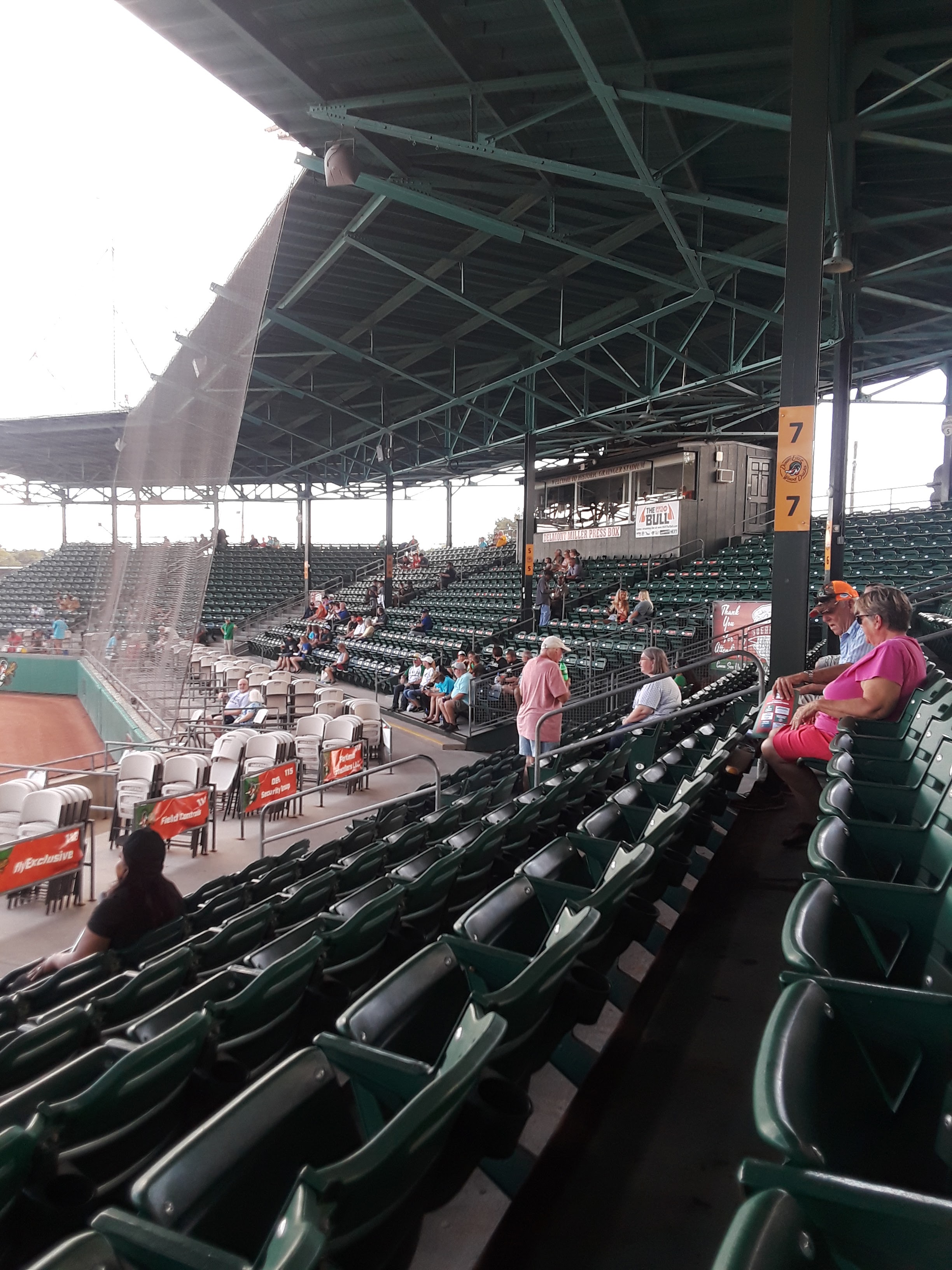
Down East Wood Ducks, Grainger Stadium, Kinston

On Saturday, August 6, on our way back to Raleigh after a family vacation at the beach, Angela and I visited Kinston to take in a game at Grainger Stadium. We watched as the home team, the Down East Wood Ducks, fell by a 3-0 score to the Fredericksburg Nationals. We seem to be a bad luck charm for the Wood Ducks; we also watched them lose at Kannapolis and at the Mudcats.

I noticed in our program that Fredericksburg's starting pitcher, Jackson Rutledge, is a former first-round pick. He looked like one that night. Angela remarked that she found this game dull. Whereas the game I found hardest to watch was the 12-10 slopfest in Burlington. I appreciated this one: a well-pitched game by both teams, the FredNats scratching out their runs one at a time. 

Kinston is a somewhat sleepy place. It was a busy tobacco market town at its peak in the 1980s. Since 1990 the overall population of the town has waned; the African-American majority has grown to 68%. As a baseball town, Kinston punches above its weight; I believe it is one of the smallest towns in the country to have a minor league team, and its minor-league history is much more extensive than more populous N.C. towns like Rocky Mount and Goldsboro. The team was called the Kinston Eagles for many years. "Wood Ducks" is a more distinctive nickname, and hey, it's a handsome species of duck and a real conservation success story.

Kinston was the home of a semi-pro Black team called the Greys, beginning in 1939. Two black players from Kinston, Donald Jarmon and Fred Hobgood, pitched in the Negro National League. I'd like to learn more about Black baseball in North Carolina in the Jim Crow era. Certainly Eastern N.C. is a rich source of Black athletic talent. In recent years Kinston has become renowned for producing a bumper crop of Black basketball players, most notably Cedric Maxwell, Jerry Stackhouse, Reggie Bullock, and Brandon Ingram. 


Somewhere I'd seen Grainger Stadium described as a gem of a minor-league ballpark. I wasn't disappointed. Dating from 1949, set in a residential area not too far from the center of town, Grainger is the second-oldest park in the Carolina League. It has ambience and compactness that reminded me of my one long-ago visit to Fenway Park. 

When in Kinston, one has to sample the wares of Kings BBQ and of Mother Earth Brewing. Both are available at the ballpark. Beers enjoyed were two Mother Earth brews: a Weeping Willow Wit, then later a Long Weekend IPA.

Here are a few baseball men who hail from east of Interstate 95:

  • Lifelong Kinston resident George Suggs (1882-1949) had an eight-season major league pitching career, mostly with the Cincinnati Reds and the Baltimore Terrapins. This article gives the lowdown on George's romantic peccadillos; he was kind of the Bo Belinsky of the dead ball era.
  • Despite not turning pro until he was 25, Buck Leonard (1907-1997) rang up a Hall of Fame career (Cooperstown Class of 1972) as a slugging first baseman. He and Josh Gibson were the biggest stars on the Homestead Grays, who won nine straight Negro National League pennants,1937-1945. Leonard returned to his hometown, Rocky Mount, after his playing career ended at age 48.
  • Clyde King (1924-2010) was a pitcher, mostly in the Brooklyn Dodgers system, mostly a starter in the minors, a reliever in the majors. A native of Goldsboro, Clyde won 14 games and saved 6 for the star-crossed 1951 Dodgers. He stayed in baseball virtually his whole life as a player, coach, manager, and executive. He may deserve sainthood for his long and constructive relationship with George Steinbrenner, 
  • George Altman (b. 1933), also from Goldsboro, had a nine-year National League career, mostly with the Chicago Cubs, and was named an All-Star in 1961 and '62. An outfielder with power and speed, Altman became one of the first American players to have success in the Japanese Leagues.
  • Jim Ray Hart (1941-2016), was a good-hit, no-field third baseman for the San Francisco Giants. He hit 139 home runs for the Giants from 1964 to '68. He finished his career with three partial seasons in the Mexican League. Hart grew up in Hookerton, in Greene County. 
  • Jerry Narron (b. 1956) is part of a distinguished Eastern North Carolina baseball family. Jerry was a journeyman catcher in the majors and minors. He then had a long career as a big-league coach, with stints as manager of the Texas Rangers and Cincinnati Reds. Narron is a Christian Zionist, and was the coach of Israel's national baseball team for a time.  

Photos by JBJ

Thursday, August 04, 2022

Burlington Sock Puppets, Burlington Athletic Stadium

Friday, July 29 saw the Burlington Sock Puppets prevail over the Bluefield Ridge Runners, 12-10. The game was marked by errors and passed balls and hit batsmen. It did seem like the guys remembered how to hit along about the 5th inning, so there were a few homers and even a couple of defensive gems, but they were outnumbered by sloppy plays. This was the longest game we've seen this season, over 3 1/2 hours, and we were pretty ready for it to be over. (Burlington is only a hour from our house, so we commuted to the game and got home before midnight.) 

The home team pulled it out, though. (They have the best record in the Appalachian League. Go Sock Puppets!) We felt lucky that the thunderstorms passed us by with only a few drizzles. The evening sky was lovely, streaked with clouds and rich colors.

The effort in recent years by organized baseball to restructure the minor leagues (i.e., shrink them for economic reasons) was one of those news stories that depressed me enough that I didn't follow it closely or understand the resolution. Part of the upshot is, the Appalachian League today is no longer a low-level pro league, a "rookie" league, but a developmental league whose players will return to their college teams next year. The players are mostly 18 and 19 years old, and all U.S. players, none from Latin American countries that I could tell. It's a short season, June 1 thru August 10, roughly. Kind of like summer camp? Are these the "best" college prospects in the country or are they self-selected in some way? Was I correct to categorize the Appy League as part of the minor league system? These are my questions.

Burlington Athletic Stadium stands out as the oldest ballpark we have visited, and the most unpretentious: metal and concrete like one of your better high-school football stadia. It originally stood in Danville, Virginia. The structure was bought by the town of Burlington, disassembled, brought in, and reassembled in time for the 1960 season. Its hard aluminum bleacher benches are a little problematic for a middle-aged person after a few hours. The park seats 3,500. Well-tended grass field. 330' down each line, 400' to center.

Photo by JBJ

Burlington has held a place in the Appalachian League since 1986. Prior to that, they had an entry in the Carolina League for about 25 years, from the mid-40s to early 70s. The ballpark is within sight of the Pioneer Plant of Burlington Mills, later Burlington Industries, which came to specialize in hosiery. So the name Sock Puppets, dating only from 2021, reflects that history. Earlier team nicknames merely mimicked the big-league affiliate at the time: the Indians, Pirates. Royals, etc. 

This area of the state was settled pretty early, pre-Revolutionary War, with some religious dissenters and Regulators in the mix. Yet there was never much of a town here until the rise of the railroads in the 1850s and the need for a repair site. The town was known as Company Shops for over 20 years. "Burlington" was chosen as the new town name on 1887, nominated by a resident who saw it on a passing train. 

Burlington went quickly from being dominated by the railroads to being dominated by the textile barons. Yet I liked the spirit in the crowd in Burlington, as downwardly mobile and unpretentious as its ballpark. We saw families, young couples on dates, teenagers screwing around behind the bleachers. 

Ballpark foods consumed: a pulled-pork barbecue sandwich and an order of barbecue nachos, which were fine. (I will say, next time in Burlington I want to visit Hursey's Barbecue, which I expect will be better than fine.) Local beer enjoyed: a Sock Puppet Pilsner by Tobacco Wood Brewing of Oxford, NC. 

Each of the following baseball gentlemen was born in the Burlington area, and three of them died there as well:

  • Left-handed pitcher Tom Zachary (1896-1969) never spent a day in the minor leagues, but appeared in 533 big-league games over 19 seasons. If you know only one fact about Zachary, it's probably that he gave up Home Run # 60 to Babe Ruth in 1927. My favorite fact, however: He was from a family of Quakers, and served with a Red Cross unit in Europe as an alternative to WW1 military service. Zachary pitched in three World Series (1924-25 with Washington, 1928 with the Yankees) and won each of his three WS starts. 
  • Garland Braxton (1900-1966), from the community of Snow Camp, was a journeyman lefty pitcher. He won 50 games in the majors, plus 193 in the minors, including some big seasons in the high minors. Started out at age 20 with Greensboro in the Piedmont League. At age 39 he returned to his home region, playing for Winston-Salem, again in the Piedmont League. Within that league, Braxton later shifted to the Norfolk (Va.) Tars, and apparently settled in Norfolk after pitching his last game at age 49. He died in Norfolk.
  • Mebane native Lew Riggs (1910-1975) was a left-handed hitting third baseman. He came up through the Cardinals system, became a regular for the Cincinnati Reds for a few years, then was brought to Brooklyn by Leo Durocher to be a pinch-hitting specialist for the Dodgers. Riggs appeared in the World Series in 1940 with the Reds and in 1941 with the Dodgers. As a youngster he came up in the minors with Dizzy Dean. As a veteran he was a member of the 1946 Montreal Royals, Jackie Robinson's first "white" professional team.  
  • Jim Holt (1944-2019) is a player I remember from my bubblegum card collecting childhood. An outfielder/first baseman, a semi-regular for the Minnesota Twins, then later a useful sub on the World Champion 1974 Oakland A's. 

Friday, July 29, 2022

Greensboro Grasshoppers, First National Bank Field


On Saturday night (July 23) the Greensboro Grasshoppers bested the Hickory Crawdads, 7-6, in a South Atlantic League tilt. It was a fun game to watch, featuring several lead changes and six home runs, two by Hoppers catcher Endy Rodriguez. 

Hickory had a relief pitcher (a righty) named John Matthews, with a conventional overhand delivery, but who occasionally dropped down to throw a sidearm breaking pitch to right-handed batters. This seems like an old-school maneuver to me, varying your motion -- like something modern pitchers tend not to do. Am I wrong?

Greensboro is familiar to me; it felt nice to come for a visit, like dropping in on an old friend. My mother lived here for several years, working in the admissions office at Guilford College, and Angela and I have had friends who grew up here or who settled here. It's got textile manufacturing in its DNA, like every N.C. Piedmont city. But the economy here is pretty diverse: finance, media, education. 

There was an important Revolutionary War battle fought here, at Guilford Courthouse. For many years, due to that connection, Greensboro's ballclub was called the Patriots. Greensboro has a rich professional baseball history, beginning in 1902. Early on, the team played at Cone Athletic Park, named for Cone Mills. From 1926 their home field was World War Memorial Stadium. When they got a new ballpark in 2005, they got a spiffy new nickname: the Grasshoppers.

For quite a few years Greensboro was a Yankees affiliate, and the heart of the great Yankees teams of the 1990s-2000s played here, including Derek Jeter, Mariano Rivera, Andy Pettitte, Jorge Posada.

First National Bank Park is handsome. I like the downtown location. It seats 7,500, which would support the team playing at a higher level than its current classification in the High-A Sally League. The photo is not quite up to date: FNB has built an office building adjoining the park on the first base side, and there are newish apartments across the street behind the outfield fence. One could sit on one's balcony and watch games, if one were so inclined. 

We splurged on good seats, behind home plate, which were comfortable and shaded. Foods consumed were gyros (quite good!) and soft-serve ice cream (tasty but a little more than we needed). Beer enjoyed was an Asheville brew, the Wicked Weed Appalachia Sessions IPA. 

Here is the baseball heroes' gallery for Greensboro and Guilford County One family stands out. There are a couple of melancholy stories in here.

  • Rick Ferrell (1905-1995) was an outstanding defensive catcher and a decent hitter, an eight-time AL All-Star. He is in the Baseball Hall of Fame; some people think they chose the wrong Ferrell brother. Rick spent many years in the Detroit Tigers' front office, where he was widely known and admired.
  • Wes Ferrell (1908-1976) recorded 193 wins, 128 losses in 15 seasons in the majors, mostly the AL. He and Rick were teammates from 1934 to 1938 with the Red Sox and Senators. Arguably the best hitter of any MLB player, ever, who was primarily a pitcher. After his pitching days were over, Wes recorded some good seasons as an outfielder in the minors. His final season was with the Greensboro Patriots in 1949.
  • A third Ferrell brother, George (1904-1987), had a long minor league career as an outfielder and third baseman. He played on the 1931 Greensboro Patriots in the Piedmont League, alongside future Hall of Fame slugger Johnny Mize. The 18-year-old Mize had a good season that year; George Ferrell had a better one.
  • Jamestown native Pep Young (1907-1962) spent 19 seasons in professional ball, parts of 10 in the majors. He peaked in 1938, starting 149 games at second base for the NL runners-up Pittsburgh Pirates. He looks to have been a slick defender. His death certificate lists him as a shipping clerk for Oakdale Cotton Mills. Pep played for Oakdale's mill team at both the dawning and the twilight of his career.
  • Bill DeLancey (1911-1946) caught every inning of the 1934 World Series for the St. Louis Cardinals as they defeated the Philadelphia A's. He was only 22, a favorite of Branch Rickey's, and seemed destined for a brilliant career. But DeLancey was plagued by respiratory issues, and died at a young age. 
  • Hal "Skinny" Brown (1924-2015) grew up in the Pomona Mills community in Greensboro. After his World War II service, he embarked on a 19-year pro career. Mostly in the majors, but I note he had some excellent years in the minors, including in the Pacific Coast League in the 1950s. Returned to Greensboro after his playing days and built a heating oil business.
  • Tom Alston (1926-1993) was the first African-American to play for the St. Louis Cardinals, in 1954. However, his career was shortened by mental health issues, which plagued him the rest of his life. It's a sad story. The Cardinals come off poorly; they lagged behind other MLB clubs in integrating their roster, and their support of Alston was as a token, not as a human being. But also, we as a society were so backwards in our views of mental illness. We still have a long way to go.

Photo by Badbadb, provided under CC 2.5 license

Friday, July 15, 2022

High Point Rockers, Truist Point


On Sunday, July 3rd, the South Maryland Blue Crabs downed the High Point Rockers by a 4-2 score, behind a three-run homer by shortstop Alex Crosby. Out of six games Angela and I have seen this season, it's the first one when the visiting team won. 

This was also the first game we've seen this year where I looked over the team rosters and recognized a couple of names. These teams play in the Atlantic League of Professional Baseball, which is an independent league. This means the Rockers and Blue Crabs are not connected to or supported by any major league team. Most players are in their late 20s or early 30s, which is a little old for a prospect. A few have some major league service time. For whatever reason, these players have left the standard pro baseball feeder system. If they have big-league ambitions, they are following a path of lateral entry. 

Another way of saying it is, these dudes, some of them at least, are clinging to a last thin shred of hope of making the majors. It's not unheard of for a guy to use the Atlantic League as a springboard to the bigs, but the examples are pretty few. The players know this. They don't look desperate or anything. They might be more relaxed than the 19-year-olds in the South Atlantic League. They seem to enjoy their jobs. They have some flair; they might put an extra flourish into a routine defensive play, for instance.

Before the first pitch on Sunday, the PA guy at Truist Point announced that tonight's would be the last game in a Rockers uniform for Johnny Field. He is retiring in mid-season. 30 years old, a Las Vegas native, Field spent most of 2018 in the American League, the majors. Then he slipped back to AAA. Then he played for a year in Australia, which it occurs to me could be a move related to the pandemic. Then he went to the U.S. independent leagues in 2021. Johnny Field went out in style on Sunday: he hit a solo home run and a single, played center field, and generally looked like one of the better players out there. He still has something left in the tank. But he has decided to start a new chapter in life, perhaps less of a longshot.

The nickname "Rockers" hearkens back to High Point's history as a center of the furniture industry. The Rockers debuted in 2019 and ended a 50-year absence for the city of High Point from minor league baseball. There was a High Point team in different leagues off and on in the mid-20th century: sometimes called the Pointers, sometimes the Furniture Makers. For over a decade High Point shared a team with Thomasville, another furniture town nearby; this hybrid team was called the Hi-Toms. (Love it! I love so many of these team nicknames.)

Mill towns and minor league baseball go together like salted peanuts and Coca-Cola. Baseball's popularity was booming at the same time as the southern mill economy, and the mills latched onto baseball as a useful diversion from the hardships of millworkers' lives. Yet the relationships between organized baseball and small regional leagues were fluid and sometimes tense. Then as now, MLB wanted a free hand to maintain their monopoly on the best players, and to expand or contract the low minors at will. The towns had ideas of their own; they were flexible and inventive in keeping their ballclubs alive. (See: the Hi-Toms.) Mills were often willing to pay players, over or under the table. MLB in response was willing to blackball players and declare whole leagues illegitimate. (I was surprised to learn that the "Carolina League" operated without MLB's blessing for a few years during the Great Depression.)  The players were scrambling and scheming, weighing their limited-time opportunity to get paid for playing, versus their need for a post-baseball livelihood. I am relying heavily for all this on a great article by John Short about the mill leagues.


Cliff Bolton (Courtesy Sports Reference LLC)

Let me tell a story about Cliff Bolton. Cliff Bolton was born in High Point in 1907 and broke into pro baseball with the High Point Pointers in 1927. He was a catcher with a pretty good bat, and from High Point and the Piedmont League he rose through the ranks, cracking the majors in 1931 with the Washington Senators. He appeared in the 1933 World Series with the Senators, going 0 for 2 as a pinch-hitter. The Senators made him their number one catcher in 1935-36. Then he bounced to the Detroit Tigers in '37, then the Tigers cut him from the roster. He was 30 years old. 

In 1938 Bolton returned to North Carolina and became the manager (non-playing) for the Valdese Textiles of the Carolina League. This was during the outlaw-league interlude that John Short wrote about. Bolton is missing from the baseball records in 1939.

In 1940 Bolton appears as a catcher again, in the Detroit system, then back in the Washington system. He had quite a bit left in the tank: he had one more cup of coffee in Washington, and played a couple of years in the high minors in Little Rock and Chattanooga. Mostly, though, he played in the Carolinas for several teams in several leagues. He played throughout the World War II years, when many younger players were entering military service. He spent four seasons with the Hi-Toms, including 1949 when he batted .399 with 105 RBIs, at age 42. His final season was 1952, divided between the Rutherford County Owls, based in Forest City, and the Lexington Indians. Bolton died in 1979 in Lexington, not far from High Point. His death certificate lists his occupation as Supervisor in a Knitting Mill. 

#

Opened in 2019, Truist Point (Truist is a bank; not sure what "Point" refers to) is clean and well laid-out for spectators. I like the downtown location. One thing bothers me, though. I immediately noticed the striking two-toned outfield turf and wondered how they achieved that effect. The answer is, the playing surface is artificial. Not just the outfield and infield "grassy" areas, but the mound and the areas around the bases, which are bare dirt in most ballparks, are covered in reddish-brown carpet. Same turf, different color, it appears. I know artificial turf is better than it used to be, but a player sliding into base and raising a cloud of manufactured particles? This is unfortunate.

Angela and I each had a barbecue sandwich at Truist Point that we rate the best ballpark food we've had this season. The soft pretzel was pretty good as well.

Paddled South Brewing Company is based just two blocks from the ballpark in High Point. I had a glass of their tangerine sour. I also had a Fiddlin' Fish Space Angler West Coast IPA, from Winston-Salem. Both very nice. 

High Point is part of the Piedmont Triad, along with Winston-Salem and Greensboro. Wikipedia tells me that High Point is the only North Carolina city that exists within four counties: Forsyth, Guilford, Davidson, and Randolph. The latter two in particular are High Point's catchment area for my purposes:

  • The brilliant and mercurial Johnny Allen (1904-1959) spent much of his childhood in the Thomasville Baptist Orphanage. He was working in a hotel in Sanford, NC when he was discovered by Yankees scout Paul Krichell. His hot temper caused him to bounce from team to team and probably hampered his success. But 142 big league wins and 75 losses is a hell of a record, and Johnny didn’t make the big leagues until he was 27.
  • Ray Hayworth (1904-2002) had a career rather like Moe Berg’s, spending a lot of years on major league benches as a backup catcher. After his playing days were over, Hayworth remained in pro baseball as a coach and scout. A High Point native, member of a Quaker family, he chose baseball over a career in the upholstery trade. His younger brother Red also played in the big leagues as a catcher. Ray was interviewed in 1999 for this ESPN film about Ty Cobb.
  • Hall of Famer Luke Appling (1907-1991) was born in High Point and has a street named for him near Truist Point.
  • Max Lanier (1915-2007) pitched in three consecutive World Series, 1942-1944, of which his St. Louis Cardinals won two. In those three series he recorded a 1.71 ERA in 31.2 innings. Max had an interesting life and career. He incurred the wrath of the baseball establishment by jumping to the outlaw Mexican League during his prime. The commissioner blackballed him, so Lanier sued the sport and challenged the reserve clause, and scored an out-of-court victory. Lanier was born and raised in Denton, in Davidson County.
  • The great sportswriter Furman Bisher (1918-2012) was also from Denton and worked for the High Point Enterprise early in his career. Bisher’s greatest fame was with the Atlanta Journal-Constitution.
  • Wil Myers (b. 1990) was the 2013 American League Rookie of the Year and is still active with the San Diego Padres. Born in Thomasville, he went to high school in High Point.

Friday, June 24, 2022

Fayetteville Woodpeckers, Segra Stadium


The Fayetteville Woodpeckers downed the Kannapolis Cannon Ballers, 4-3, on Father's Day (Sunday, June 19) in Fayetteville. In contrast with Durham's rapid shuffling of pitchers the other night, Fayetteville's starting pitcher, Edinson Batista, threw six shutout innings.

There were a couple of moments that told me we were watching a Class A game, not AAA. One was when a Kannapolis outfielder caught a long fly ball and started to jog toward the dugout before teammates yelled at him to make a throw. He must have forgotten how many outs there were. Not one but two runners tagged up to score. Given the closeness of the game, that was a big goof. 

Another was Fayetteville's second pitcher, a young man named Schroeder, who was simply the wildest pitcher I can ever remember seeing. He made it through one inning and was charged with three wild pitches, but two or three more went to the backstop, and in the scariest moment, he hit a batter on the helmet, right above his ear. The batter was okay, thankfully. Somehow only one run scored.

Angela lamented the fact that we were watching the Ballers versus the Peckers. But like the Cannon Ballers, there's some background to Fayetteville's team name too. It is tied to the red-cockaded woodpecker, an endangered species whose cause is well-known around these parts.

Segra Stadium, opened in 2019 and located on Hay Street in downtown Fayetteville, is new and nice. I liked the "see-through" fence in left field with the bullpens behind it, and I loved seeing and hearing the freight train rumbling past beyond left field. The outfield dimensions marked on the fences are 340' to left, 400' to center, 325' to right. The park holds 4,786 spectators. 

Ballpark foods sampled: a cheeseburger and fries, and a pulled-pork sandwich and hush puppies.  My ballpark beer was the Namaste Lavender Ale from Fayetteville's Gaston Brewing Company

Fayetteville sits in the Sandhills, a geological zone on the upper edge of the coastal plain, extending into South Carolina. Fayetteville has fielded a professional team off and on in various leagues since 1909. For several years the team was called the Highlanders or Scotties, referring to the Highland Scot migration to this part of the state in the 1700s. Later it used the name Generals, related to Fayetteville being the home of Fort Bragg and the U.S. Army 82nd Airborne.

  • Rube Benton (1890-1937), from Clinton, was a rounder. Someone should write a song about him. He won 150 games as a National League pitcher and 172 more in the minors. He was the losing pitcher in a famous game in the 1917 World Series. Witnesses connected Rube to game fixing during the Black Sox era, though he was never banned from organized baseball. Died in a car crash a long way from home.
  • The real Moonlight Graham (1877-1965) was born in Fayetteville. So was the real Austin Warren (b. 1996), currently building his Baseball Encyclopedia entry as a relief pitcher with the Los Angeles Angels.
  • Taffy Wright (1911-1981) grew up in Lumberton, in Robeson County. A professional hitter for 9 seasons in the majors and 12 more in the minors, with 3 years of WW2 military service in the middle. Is sometimes credited as the 1938 American League batting champion, with a ridiculously low number of plate appearances (281).
  • In 1914 Babe Ruth hit his first home run in a professional uniform, that of the Baltimore Orioles, during an exhibition game in Fayetteville.

Thursday, June 23, 2022

Durham Bulls


After a thunderstorm passed through, delaying the first pitch for about an hour, the Durham Bulls trounced the Louisville Bats, 5-0, at Durham Bulls Athletic Park on Friday evening, June 17. My wife and I were joined by two of my daughters, one daughter's domestic partner, and my dad, in an early Father's Day celebration.  The game was followed by a pretty great fireworks show. 

I never thought I'd see the winning team in a shutout game use six pitchers, but the Bulls did, by design I'm sure. There were no mid-inning changes to slow the game down. Catcher Joe Hudson was the player of the game, for his opposite-field two-run homer and for handling all those hurlers. 

The Durham Bulls have operated in organized baseball most seasons since 1900, in various leagues. They have paused only for major national emergencies: World War I, the Great Depression, the COVID pandemic, and the disco era. 

Durham was an important manufacturing center in postbellum North Carolina. Textiles and, especially, cigarettes. In the late 80s, especially on summer mornings, the city smelled like an unlit cigarette. Bull Durham was a popular brand of tobacco dating from 1874. It gave the local team its name, and it's among the best team names in American sports: pithy, distinctive, tied to its hometown. Also, bulls are majestic and fearsome, unlike Senators or Twins or Banana Slugs or a lot of mascots I could rattle off. 

The 1988 baseball movie directed by Ron Shelton, starring Kevin Costner and Susan Sarandon, could have been set in a number of minor-league towns. It came to life as Bull Durham, the charming and perennially popular rom-com set in Durham and the Carolina League. It showed Durham in a good light, not to mention minor-league baseball. It gives the Bulls name recognition and a marketing hook no other minor league team can match. 

In the wake of Crash Davis, Nuke LaLoosh, and Annie Savoy, the ballclub's profile rose. As results of that, the Bulls got a new stadium in 1995 and a promotion to the Class AAA International League in 1998. In another lucky break, since rising to AAA, the Bulls have been a Tampa Bay Rays affiliate. Tampa Bay has its problems, but it's really good at drafting and coaching up young prospects, and in those 20+ years, only 4 years have seen the Bulls finish under .500. 

The DBAP was tied in to the American Tobacco Campus urban rehab project and an overall period of growth and renewed vibrancy for downtown Durham. The stadium was designed by the same architects responsible for Baltimore's Camden Yards, the catalyst for a wave of neo-traditional downtown baseball parks in many MLB and MiLB cities. All of which is to say, the DBAP is pretty great, and within walking distance of lots of fine eating and drinking places. The Camden wave of parks were quirky and asymmetrical. In the left field corner the DBAP has a short 303' fence, but a 32' tall "Blue Monster" to compensate, topped by the famous Bull sign. Center field is 395', and it's 329' down the right field line. The DBAP seats 10,000 fans. Friday night post-game fireworks have become a regular feature.

Ballpark foods consumed by me: a hot dog with chili and slaw, and most of an order of BBQ nachos - messy, unhealthy, but good. Others in my party consumed pizza slices from Pie Pushers. Ballpark beers enjoyed: the Red Oak Hummin'bird Helles Munich Golden Lager. But there are a lot of beers and ciders to choose from.

Durham is the northernmost point of the Research Triangle. My idiosyncratic definition of the "Durham region" is a broad sweep of the Piedmont north of the city to the Virginia line, including all those towns along I-85 North. This part of the state has spawned its share of notable baseball figures, particularly around the turn of the 20th century.

  • George "Possum" Whitted (1890-1962) spent 11 years in the National League as an outfielder and utilityman. He was a key player on the 1914 "Miracle" Boston Braves. Born in Durham. After leaving the majors, Whitted did a spell as player-manager of the Durham Bulls.
  • Jack Scott (1892-1959) grew in Ridgeway, in Warren County, and had a 12-year National League career. He had some bad seasons with bad clubs, as well as good seasons with good clubs. His finest hour was throwing a shutout for the New York Giants over the crosstown Yankees in the 1922 World Series. He spent some time with the Bulls in 1913-14.
  • Born and raised in Oxford, in Granville County, Lee Meadows (1894-1963) won 188 games as a National League pitcher. He had the honor as a Pittsburgh Pirate of getting roughed up and losing a start to the Yankees in the 1927 World Series. A sometime teammate of Possum Whitted's, Meadows started and ended his pro career with the Durham Bulls.
  • Enos Slaughter (1916-2002) was a native of Roxboro in Person County. He got his start in baseball with a textile mill team in Durham, where he caught the attention of the St. Louis Cardinals organization. He went on to play in five World Series, winning four of them, and was elected to the Baseball Hall of Fame in 1985. Later in life he coached the Duke University baseball team. I met him once, at a Duke basketball game.
  • Durham native Roger Craig (b. 1930) had a career much like Jack Scott's for the Brooklyn and L.A. Dodgers, the original Amazin' Mets, and the Cardinals. Not a star, just a pretty darn good pitcher. Craig won two games and lost two in the four World Series he pitched in, collecting three rings. As an MLB pitching coach he had a major impact in the 1980s as a teacher and proponent of the split-finger fastball. He also managed in the big leagues for 10 years.


Thursday, June 16, 2022

Kannapolis Cannon Ballers, Atrium Health Ballpark


The Kannapolis Cannon Ballers held on to beat the Down East Wood Ducks, 2-1, in a Carolina League contest last Saturday night (June 11) with Angela and me in attendance. The home teams are now 3 and 0 in the games we have seen this season. The Ballers made it interesting as their 9th-inning reliever issued walks to the first two Woodies hitters, but stranded them to record the save. It wasn't pretty, but it counts the same. Player of the game was catcher Victor Torres, who threw out a would-be base stealer and launched a solo home run to left for Kannapolis's first run.

We were piddling around the house Saturday morning, neither of us in any apparent hurry, and I asked, "Are we gonna do this Kannapolis thing?" Mostly what I knew about Kannapolis is that it was at one time the Towel Capital of the World, built by (and named for) the Cannon Mills Corporation, which went the way of the rest of the N.C. textile industry in the 80s and 90s. I'd driven past Kannapolis on I-85 many times without ever stopping; I guess I figured I would find a dilapidated mill village, the ultimate company town whose company fled and left a crumbling wreck behind. 

We did do the Kannapolis thing (these ball games are not gonna attend themselves), and I'm glad. Kannapolis turns out to be an attractive town, with a busy central district that includes the ballpark. Angela and I were both struck by the Cannon Baller brand and logo. It pays tribute to the Cannon name as well as to Kannapolis native and NASCAR legend Dale Earnhardt. (The picture above is of a statue of Dale, located downtown near the Kannapolis Amtrak station.) 

If you can stand to read news from the world of sports marketing, I found this article to be illuminating, both about the minor-league baseball biz and about Kannapolis's pursuit of a vision for itself that acknowledges the past but isn't burdened by it. 

Atrium Health Ballpark opened in 2020, part of the larger plan of downtown development; it is new and clean and fan-friendly. Being in a walkable neighborhood is a big plus in my book. 325' to left field, 315' to right.

Ballpark foods consumed were an Italian sausage and chicken sausage sandwich (tasty though we felt they were a little small given the price), and two cups of soft serve ice cream. Ballpark beers enjoyed: two by the Cabarrus Brewing Company of Concord, the Cabarrus Cotton Blonde Ale and the Concord Amber Lager. 

Shout-out to Sweet Meadow Cafe in downtown Salisbury, NC, who serve an excellent Sunday brunch in a cool, quirky atmosphere.

In searching for Central North Carolina Piedmont natives in the annals of baseball history, I almost overlooked two prominent contemporary players:

  • Kyle Seager, Seattle Mariners third baseman from 2011 to 2021, now retired, and Corey Seager, Texas Rangers shortstop, 2020 World Series MVP as a member of the L.A. Dodgers. The Seagers were raised right in Kannapolis and both are All-Star caliber players.
  • Billy Goodman was born and raised in the neighboring town of Concord. A long-time teammate of Ted Williams on the Red Sox, Goodman appeared in two All-Star Games and is credited as the AL batting champion for 1950, all while rarely holding down a regular spot in the defensive lineup. He could play almost anywhere in the field and had a knack for getting on base, which is a good recipe for a 16-year big league career. Goodman appeared in the 1959 World Series with the White Sox.
  • The preceding guys were from Cabarrus County, but the neighboring county of Rowan produced notable major leaguers Vern Benson, Bill Baker, Clyde Kluttz, and Jay Ritchie. Benson and Kluttz each had long post-playing careers as coaches and scouts.