Thursday, December 31, 2020

Wes Unseld


Wes Unseld had no flair, and what made him a great basketball player defies easy description.  I grew up in the D.C. suburbs, so Wes's Washington Bullets were my team, and I saw Wes play several times at the old Capital Centre.  But it was Julius Erving of Philadelphia whose poster I had on my wall. Wes Unseld had no posters or highlight reels to his name.

Burly and immensely strong, he stood about 6’6”, a substandard height for an NBA center. He was a slow runner, a poor outside shooter, and as for leaping, well, he was definitely governed by the law of gravity. But in addition to gravity, Wes had gravitas: his poker face communicated calm intensity. He used his bulk to maximum effect, on defense and box-outs and screens. Also, Wes had great hands, strong but dexterous. He spent little time holding the ball, but when he had it he usually did something positive with it: he grabbed tough rebounds, made quick shots in traffic, putbacks and short hooks mostly, and made purposeful passes.

In particular, Unseld became known as the master of the outlet pass, the one that starts the fast break after a defensive rebound.  Let's face it, if a guy gets to have a superpower, outlet passing is a very esoteric choice. But it combined all Wes's gifts: those great hands, that core strength, his quick mind and aggressive attitude. Outlet passes are hard work, they're "hockey passes" that usually don't show up in the statistics. They're a mark of a winner and a leader.

Clearly, his contemporaries saw something special in him. In 1968-69, his first season with the then-Baltimore Bullets, despite scoring at only a 13 ppg rate, Wes was named NBA Rookie of the Year and Most Valuable Player, a rare double distinction. Perhaps the voters saw Unseld as an inheritor to Bill Russell: the center whose stardom consisted of defense and rebounding rather than scoring. The most impressive stat may have been the Bullets' won-loss record, which improved by 21 games in Unseld's first season.

But no team would inherit the mantle of Russell and the Celtics. The decade of the 1970s in pro basketball was turbulent. No NBA team even defended their league title successfully (in other words, no repeat champions).  The best player of the ‘70s was Kareem Abdul-Jabbar, but only in 1971 did Kareem’s team assemble enough talent around him to win a title. (He made up for lost time in the '80s with the Lakers.) Most years, one team had to scrap and claw and limp and enjoy a few lucky breaks along the way to win in the playoffs.

The Bullets best exemplify what I mean. With Wes’s rookie year, they started a run of 12 straight seasons making the playoffs, with a constantly evolving lineup, Unseld the single common denominator of all those teams. Defense was the Bullets' calling card, especially in the half-court and in the paint, in Wes's domain.

They won four conference championships in the ‘70s.  In two of those years, they were favorites to win the Finals, but got knocked off.  But they hung around, and in 1978, after an injury-plagued regular season, several things broke in their favor and cleared their way in the playoffs: 

  • Portland were the kings of the West and owners of the best record in the NBA before Bill Walton broke his foot, which doomed their chances.  
  • Philadelphia’s run-and-gun team of Dr. J, George McGinnis, and World Free crashed and burned, falling in an upset to the Bullets in the Eastern Conference finals. (McGinnis and Free would be gone the next season.)
  • At the end of a grueling Finals between Washington and Seattle, the Sonics' Dennis Johnson shot 0 for 14 from the field in Game 7, a historically bad performance and highly uncharacteristic of DJ.

It’s hard for me to think of Wes’s playing career without thinking of Elvin Hayes alongside him. The Bullets would always need a primary scorer to make up for Wes's shortcomings in that area. In the early years that was Earl “The Pearl” Monroe, who had the playground style and scoring potency that Wes lacked. After Monroe left for the bright lights of New York, the Bullets brought in Elvin.

In contrast to Unseld, Hayes preferred to do things that show up in the stats.  He had a trademark shot, a turnaround jumper, and he dunked and blocked shots. He was more fun to watch, and my 14-year-old self in 1978 considered Elvin the star of the Bullets, not Wes.  Later I would learn that Hayes was often considered a selfish player and was not held in the same respect as Unseld. But on the court E and Wes complemented each other. Both of them were later named to the 1996 list of the NBA’s Top 50 players. Each of them had flaws, but the two of them roughly added up to one NBA championship-caliber center.

In that Game 7 against Seattle in '78, helped by DJ's historic goose egg, the Bullets led by 13 at the end of the 3rd period.  But the Sonics mounted a 4th-quarter comeback, and Elvin Hayes fouled out early. Wes would end up with 5 fouls himself, and would struggle to keep Marvin Webster and Jack Sikma at bay. He posted a classic if unspectacular Unseld stat line: 15 points, 9 rebounds, 6 assists.  The Bullets held on, winning the franchise's only NBA title, validating a decade's worth of tough play and persistence, and the NBA Finals MVP award was bestowed onto Wes Unseld.  There is poetic justice there.

Wes Unseld died on June 2, 2020, in Baltimore. The obituaries I saw emphasized his long years of loyal service with the Bullets/Wizards, including stints as head coach and general manager after his playing days ended. He was a one-club man and an outstanding citizen of Baltimore.  But it seemed to me there was a shortage of tributes to Wes’s play. Wes was unique, he competed on a team and in an era that deserves more notice, so I decided to share some impressions.

Monday, March 02, 2020

New Holland


What is a staunchly conservative Dutch Reformed Church doing in the tiny, remote Eastern N.C, community of Pantego?

Well, it turns out that 25 Dutch families settled in Beaufort and Hyde Counties, beginning in the 1910s, displaced by WW1 and finding the marshy area around the Inner Banks to their liking.  What's an activity the Dutch are known for?  Draining wetlands.  After that?  Growing cut flowers.  The Dutch arrived as part of the effort to drain Lake Mattamuskeet.  When the drainage project ended, and Mattamuskeet was restored as a wildlife refuge, some of the Dutch turned to raising cut and bulb flowers, and some continue to this day.

(Photo by John Wenzelburger, CC BY-NC 2.0)

Monday, February 17, 2020

Desire Path

You've no doubt noticed the paths that form on a college campus, or in a park, or other grassy place with a lot of pedestrian traffic -- the paths that weren't laid out by any landscape designer, but are created by the footfalls of actual people finding the best ways to get to where they need to go. 

The term for these unplanned user-created trails is desire paths.  It can also refer to deer paths or other non-human highways.  The presenter in the linked TED talk says that the designer's job is to see where the desire paths occur and then to pave them.

Desire Paths would be a good title for something.

Wednesday, February 12, 2020

Transcribing

A potentially fun, fairly easy, and potentially benevolent activity: being a volunteer online transciber for the Smithsonian Institution.  More details here:

https://transcription.si.edu/browse?filter=owner:1

Friday, January 31, 2020

founding fathers

Typing the title of this post sent me on a mental tangent: We took my father out for dinner for his birthday last week, my brother and I and our wives.  Dad is a rare specimen, a type that political reporters constantly seek and rarely actually find: a well-informed, judicious, thoughtful political independent: a swing voter.  And Dad despises Donald Trump, which is something our party of five could agree on.  However, as we learned while we chatted over Tex-Mex food, Dad is reading a biography of Jefferson, still a hero of his.  (He may be reading Dumas Malone on Jefferson.  Nobody reads Dumas Malone any more.)  Dad expressed a disdain for Alexander Hamilton, not understanding where the wave of Hamilton-mania comes from.  Something to record about this era in my American life: the shift in view of U.S. history as basically full of racism, injustice, and horror.  This is basically my children's view.  Increasingly it is my view.  For my parents, American history is still a story of heroic (white) leadership, bravery and honor.  I am in the middle here.  The shift is wrenching and it's personal; it's a point of stress in my family.  There is more to write here; maybe another day.

Originally, I wanted to post something today in response to the U.S. Senate folding on impeachment. (Specifically the GOP Senators, and most conspicuously Lamar Alexander, tarnishing his reputation in his last act before retirement.  These people are at their preening pompous worst at moments when they represent the tipping point, the 51st vote.  They love that attention.)  I'm angry and despondent, but trying to come away with a lesson here, more valuable than "our politicians suck."  Yes, GOP pols in this age are craven cowards, but the Trump presidency has revealed the weaknesses and limits of the U.S. Constitution.  Impeachment is poorly designed.  The drafters of the Constitution did not foresee the development of political parties.  And Watergate (which many of us, 10-year old Me included, interpreted as proof that The System Works) was an anomaly, considering that the Democrats had controlled Congress for 40 years at that point, and the U.S. was still in its weird Jim Crow configuration cross-cutting the parties, so that Southern racists tended to be Democrats.  That's the era of bipartisanship that so many in D.C. hearken back to.  Nobody should want to go back to those days.  Full explanation below.

https://twitter.com/jtlevy/status/1223263014385745925

Friday, January 03, 2020

Bounty Hunting

https://www.vox.com/2020/1/3/21035114/bounty-hunter-money-income-job

I once met the guy who at the time was pastor of a church in Robbinsville, North Carolina.  Upon moving there, he found the locals to be distinctly standoffish and suspicious.  Eventually someone explained to him that the people who founded the town included several bounty hunters, whose occupation made them aloof and wary, and that fact colored the character of the town many decades later. 

Friday, December 29, 2017

Sam Wells

Another bookmark.  Sam Wells, writing in The Christian Century about a clergy reflection group he ran, one of whose members divulged that she was gay. (A version is in the January 3 print edition.)

Saturday, October 21, 2017

Friday, June 30, 2017

Dogged defender of science and human rights

My wife asked me yesterday if I wanted to go with her to a talk that evening at the museum where she works.  I think she said the topic was the flora and fauna of the Holy Land.  I can’t say the topic captivated me, but it sounded like a cheap date for a Thursday evening.  The museum cafĂ© has good sandwiches and cold micro-brews on tap.  So I said sure.

Now I’m curious what her ulterior thinking was.  The speaker, I now know, was Dr. Mazin Qumsiyeh, Director of the Palestine Museum of Natural History.  The museum, located in Bethlehem in the West Bank, is a shoestring operation – Dr. Qumsiyeh himself draws no salary -- so he is touring the U.S. raising money and making connections to support his work.

Qumsiyeh was in town yesterday in his capacity as a scientist.  At other times, he acts as a human rights activist and overall thorn in the side of the Israeli government.  I suspect my wife simply wanted to show up in support of this guy.  His name had provoked a lot of calls from local Jewish groups wanting the museum to cancel his appearance.  He also attracted the attention of U.S. Homeland Security when he entered the country.  He might allow himself to complain about these things on his blog, but the bastards couldn’t stop him.

His talk, to be honest, was a little dry.  He was not an ace presenter: mike held too far from his mouth, PowerPoint slides a little too crowded.  But his lack of pizzazz worked, by way of contrast, to enable the power of science, facts, reason, to cut through the scrim of political posturing.  For example: Access to drinking water is a looming crisis in the Middle East.  Israelis consume several times as much water per capita as Palestinians – and West Bank settlers consume more than other Israelis.  Qumsiyeh underscored the point with a simple bar chart.  Second example: Some parcels of West Bank land were set aside for their environmental value, only later to be filled chock-a-block with ugly concrete settlement flats.  Qumsiyeh had the before-and-after photos.

Though I didn’t know what I had signed up for in advance, it was inspiring just to learn about Dr. Mazin Qumsiyeh, to be reminded that people like him exist in the world.  The theme of the evening was the struggle for environmental justice.  That includes the struggle of oppressed people, young and old, merely to learn about and appreciate the natural world.  To assert that a nature museum should exist at all in the West Bank, is to assert something about basic human worth.


The Q&A may have been better than the scripted talk; the audience had thoughtful questions.  One question linked the injustice of the Likud government to that of the American GOP, and the long-run futility of the Haves being punitive toward the Have Nots, instead of looking for win-win policies.  In the end, we’re all in the same boat and are fools to think otherwise.  Pollution does not recognize borders or factions.  Fortunately, nature still exists, life is tenacious, even in a landscape blighted by war and military occupation.  

The Israeli government refuses to build adequate sewage facilities in Gaza.  So the people there dump raw waste into open sewers.  The waste then flows to the sea, and the prevailing currents send it to Tel Aviv and Jaffa.  “They are swimming in the shit of Gaza.”  That was the rhetorical high point of the evening.  

Wednesday, March 01, 2017

Naming Things

Bookmarking Masha Gessen.

The big disconnect in this blog is that I have hardly written a word about Donald Trump, who has been dominating my consciousness, as well as the country's, for the last 18 months.

I look forward to the day sometime in the future when the country reaches some kind of consensus about what the Trump Ascendancy meant.  What's difficult right now is the heightened sense of anxiety and confusion, of cognitive dissonance, that so many of us feel.  It's been barely a month since Trump's inauguration, but it feels like years.

Even Trump supporters, I imagine, must be confused about the wave of resistance that has swelled SINCE the election. It certainly says something not-so-good about the American left-liberal side, that it appears we really got motivated only after the votes were cast.  We were complacent, and now we're full of recriminations and denial.

The Democratic Party is still groping for unity.  It's still divided along the roughly the battle lines that formed between Hillary Clinton and Bernie Sanders during the primaries.  We just had a race for DNC Chair, something I don't think is worth much worry, given the tiny ideological distance between the two leading candidates.  But Bernie people became invested in Keith Ellison, and Hillary people gave some degree of behind-the-scenes institutional oomph to Tom Perez.  Perez won, and instantly anointed Ellison as his Vice Chair (it seems by advance agreement, whoever had lost would have joined sides in this way).  But many Bernie people feel slighted nonetheless.

Today I want to note something.  I hope that, eventually, it will be hard to remember this.  It's still unclear how much credit for Trump's election is due to the clandestine efforts of business and government forces in Russia.  Plainly, Vladimir Putin wanted Trump to be elected.  Whether Putin and his collaborators really pulled it off--I hope history will rule decisively on that question.
Right now this is a point of contention between "the Left" (Bernie people, The Nation magazine, Glenn Greenwald) and "liberals" (Hillary people, Lawyers Guns & Money).  To some on the Left, invoking Putin's name as an anti-Trump epithet is an act of red-baiting, reminiscent of Joe McCarthy. 

I find this condescending in the extreme.  I've paid enough attention in my lifetime to have noticed that the Soviet Empire crumbled, and Russia pivoted from a socialist state to a right-wing authoritarian state.  There's a big difference between Putin and the oligarchs, and the old Soviet leaders and state structures.  It would be stupid not to notice the difference.  It would be highly disingenuous to pretend not to notice.  I strive to be neither stupid nor disingenuous.  PUTIN IS ON THE RIGHT.  Surely the Democratic Socialists of America and The Nation can agree to this.  Glenn Greenwald may be beyond hope.

We need brave and steady voices to help us cut through the chaos and tension of the moment. Indivisible, an organization founded by Democratic Hill staffers, is one; its mission is to give smart tactical advice to the anti-Trump resistance without blunting the urgency of that resistance.  Masha Gessen, Russian emigre journalist, is another.  Here she is talking about Trump and Putin, and about a conspiratorial view of world events versus a chaos-theory view that I incline toward.

Sunday, February 19, 2017

Robeson

Bookmarking: The Raleigh N&O has an investigative piece today by Joseph Neff, about a 28-year-old death investigation.  Civil rights lawyer Julian Pierce was murdered in 1988, in the midst of an election campaign for a judgeship.  The chief suspect in his shooting conveniently turned up dead himself, in what was ruled, incredibly, a suicide.  Pierce, a Lumbee Indian, was promising to push for school desegregation and other legal reforms in the corruption-filled swamps of Robeson County, NC.  Pierce's opponent in the judicial race was Joe Freeman Britt, notorious as the World's Deadliest Prosecutor, seemingly able to get a capital conviction against a ham sandwich.  There are whispers of law enforcement and drug dealers being involved in Pierce's murder.  His daughter is pressing to get the case reopened, and is meeting a lot of resistance.

I've long been fascinated by Robeson County, a lawless place, racially divided almost into thirds among white, black, and Lumbee residents.  (It is the center of gravity for the Lumbee band, a caste of gypsies among gypsies, which has strived futilely for decades to get federal tribal recognition.) But more than that, my historical consciousness has been heightened by the dizzying reality of the Trump presidency.  It feels like the most awful political twist ever.  Of course, Americans of color will quickly set me straight about that.   In the South especially, it was hair-raising, the racist violence that small-town sheriffs and prosecutors could get away with.

So I'm fixing on these facts of our civic life, that seem horrific by my lights today, but were accepted as thoroughly "normalized" not so long ago.  A candidate for judge was shot dead!  In 1988, when I was of voting age and registered here!  I don't remember being aware of the case at the time.

Another example: A Facebook friend in Raleigh got his hands on a sales flyer for his neighborhood, which was developed in the 1950s.  A nice leafy neighborhood now, in a voting precinct that probably went for Hillary last fall.  The brochure has a bullet point reading, "RESTRICTED FOR YOUR PROTECTION."  It clearly refers to a No Blacks covenant in the real estate sales contracts.  There are lots of people still around for whom that is a living memory.  The realtor is still in business.

Today, for a political campaign in a rural corner of the state to end in an assassination -- that would beggar belief.  In 1988, however, it was plausible.  And what remains today is an unwillingness to confront the wrongdoing and its implications.  We blanch at actual violence or brute statutory discrimination such as our parents or grandparents engaged in.  But we generally refuse to confront the consequences of our recent history responsibly.  It's very uncomfortable for officials to publish the truth and administer justice, be it financial reparations to victims or criminal convictions against the culpable people who are now honored dead or respected elders, therefore "harmless".

Here's a great dramatic detail.  Julia Pierce, struggling to get her late father's case reopened, finally got a meeting last year with the State Bureau of Investigation.  Without warning her, they invited the retired SBI agent who'd originally handled the case to the meeting, and let him do most of the talking.  He came off as a tad defensive: 

“If your theory is true, I’m either incompetent or dishonest,” Bowman said on an audio recording of the meeting. “So which is it?”

Well, sir, you don't appear to be incompetent. 


Tuesday, January 03, 2017

Winter 1988, Pennsburg, PA


One morning last winter, I got in the car and turned on the windshield wipers when they were frozen tight to the glass.  Which glitched the little motor on one side, so now the wiper arms are cattywompus, moving out of sync.  After several minutes of wild waving, they get jammed together, then I have to pull over, step out in the rain and free them.

Tuesday, February 02, 2016

The Banality of Evil, Groundhog Day Edition

I'm sitting in Sola coffee shop in north Raleigh.  At a table near me are two semi-stylish business-casual white guys.

I catch a mention of church, this or that church with X thousand worshipers.  So I figure these guys are preachers or evangelists, church planters.

Then I hear a reference to crisis pregnancy centers. 

In other words, these are misogynist rat bastards.  Warlocks in shepherds' clothing.  Their business is to browbeat young women into not having abortions. 

It was probably about two years ago that I was sitting in Helios coffee shop, downtown, near the state capitol.  I was overhearing a group of suit-wearing types discussing lobbying strategy.  Eventually I realized they were out-of-state operatives who'd flown in on behalf of the charter school industry.  I.e. infiltrators, saboteurs, dedicated to destroying public education, to hollowing out the schools my children attend. 

Different flavors of poison in different parts of town.

Election 2016: The Hokey-Pokey


They caucused their asses off in Iowa yesterday.  Whatever that means -- bundling up and trudging out to the local VFW hall to play some amalgam of Red Rover and the Hokey-Pokey.  There's probably some arcane system of hand signals adapted from livestock auctions.  I don't quite understand it, but the pundits assure me, the Iowa Caucuses are essential to America's greatness and to our presidential politics being a true test of leadership.

For my job I've been moving to a new office the last few days, a.k.a. filling boxes with unsorted scraps of my notes, work-related and not.  Numerous blog posts that died a-borning.  I spied one yesterday in which I was expecting Hillary Clinton to have a smooth ride to the nomination.  This time around, unlike Hillary v. Barack in 2008, it would not be a fight for the soul of the Democratic Party.  (I guess I jotted these notes about the time Bernie Sanders announced for the presidential race.)

Whoops!  I guess the soul of the Dems is always up for grabs.  A new crop of youngsters has emerged to fill the leftier-than-thou wing where I used to sit.  It's Bernie Sanders or nothing for them.  Better Donald Trump should win the White House than let DINO Hillary take us back to the days when AOL was riding high and Bill Cosby was America's Dad.


It really never is easy where Hillary is concerned.  She's cursed.  Maybe not fatally cursed, to the extent of being unelectable in the general.  But eternally haunted. 

Listen, I like Bernie.  I expect I'll be voting for him when our state's primary comes around.  But the imperative is for the Democratic candidate to win in November, whoever that candidate is.  I figured a Bernie vote would be a message vote, intended to pull Hillary to the left.  Now, is it simply a Bernie vote?  I'm not sure what to root for in the primary; a number of bad scenarios present themselves. 

The shit on the Republican side is so crazy, I don't see how they get their act together by fall.  But I fear their knack for ignoring inconvenient realities, joined to their sharklike sense for blood in the water. 

So the forecast is for nine months of anxiety, distrusting the media, and distrusting my own instincts.  


Thursday, January 28, 2016

Reviews I Read, Books I Want


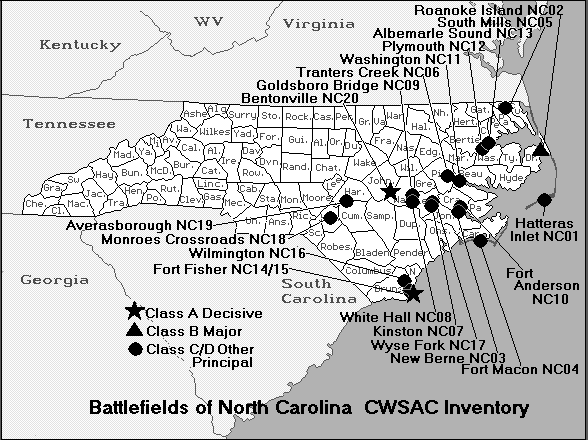
Noted in last Sunday's paper: In conjunction with the Civil War sesquicentennial, our state Archives engaged a writer/cartographer to do a coffee-table book treatment of the Civil War in North Carolina.  It's here.  It's real and it's spectacular.

Here we have a confluence of three things that have become of distinct interest to me in recent years: (1) maps, (2) the Civil War, and (3) acquiring the major works of N.C. history and geography.  So I think I'd like to get my hands on this.  Being that it's $85, though, I think I need to remember to ask for Christmas or my birthday...


The Old North State at War: The North Carolina Civil War Atlas
By Mark Anderson Moore with Jessica A. Bandel and Michael Hill
Office of Archives and History, North Carolina Department of Cultural Resources, 190 pages, $85
http://nc-historical-publications.stores.yahoo.net/

Read more here: http://www.newsobserver.com/entertainment/books/article55479830.html#storylink=cpy

Monday, January 11, 2016

David Bowie, 1947-2016


Well, today has been given over to feeling sad about the passing of David Bowie. 

Several friends are crying this morning.  My daughters are bummed out as well, whereas they are indifferent to a lot of classic rock era figures.  My sense is that LGBT kids and their allies still look to Bowie as a pioneer in crossing and blurring gender lines.

My late uncle Palmer was closer to a big brother to me than a father figure, being nine years younger than my mom, his sister. Palmer had a good album collection when I was a kid, and he used to give me listening advice.  When I was 10 or so, Palmer told me the king of rock music was David Bowie.  I took this as solid-gold gospel truth!  In later years Palmer’s advice was not always so good, but in 1974 or ’75, he was right on target.  His favorite Bowie album was Ziggy Stardust, and that remains the one I know best. 

Let’s Dance was featured in the soundtrack of my college days.  My friend Will and I saw Bowie in concert at the Scope, Norfolk, VA, on the Serious Moonlight tour in August 1983.  This was probably the most straightforward play-the-hits tour he ever did.  Serious fans would say that was not Bowie’s creative peak, but if you could only see him once in your life, that might have been a good time.  He and that band (I can hear Bowie bellowing the name CAHLOS ALOMAH) were utter pros. 

He had just released an album which by all accounts is very good.  I assumed he was in top form.  He really kept a lid on the news of his cancer, so everybody is shocked.  Actually, it’s more than that: He was so vital and so protean, it’s shocking to learn that he was mortal.

Not too long after I started working here at the seminary, folks in my office learned we would be entertaining a guest for several days -- a bishop from the Church of Norway.   (He was studying the likely fallout if the C of N was disestablished.)  In my mind's eye, a bishop of Norway was a stern creature, someone like Gandalf, tall, unsmiling, white haired and about a thousand years old.  When Harald turned up, he was this sprite of a guy, a little older than I, with modish long hair, a black denim jacket, and a hoop earring in each ear.  He was smart, funny, utterly charming, and made me feel about 200% cooler in his presence.  He was a delight, and the way I summed him up to people was: "He reminds me of David Bowie!"

Tuesday, December 01, 2015

All time basketball team

On drive-time sports talk radio today, they were debating whether Kobe is one of the top 10 players of all time.  I'd say yes, probably -- this is my list of the top 12.

hakeem olajuwon
kareem abdul-jabbar
bill russell
wilt chamberlain
shaquille o'neal
michael jordan
kobe bryant
larry bird
magic johnson
lebron james
dwyane wade
tim duncan

Criteria: (1) Huge alll-time numbers, (2) starred on more than one NBA title team, (3) score high on the advanced stats at basketball-reference.com -- Player Efficiency Rating and Win Shares -- even though I don't completely understand those. 

Bill Russell, I take on faith a little bit.  His offensive stats are not that great, of course, but he has the highest career Defensive Win Shares total, plus all those rings.

Monday, August 31, 2015

Bucket List of Trails

My wife took a business trip last week to the Canadian Rockies, including Banff National Park.  She had responsibilities, so it wasn't a pleasure cruise, but the hiking and sightseeing opportunities in Banff made me jealous.

I suppose it was my Western-Canada envy that made me delve into the National Geographic website and its lists of fabulous hikes.  I constructed this fantasy list of trails I'd like to take, and I post it here for my convenient reference.  Criteria: I was looking for mostly day hikes, without any special skill required: no ice, no rock climbing, no caves, no guides, no orienteering.  I have stuck to North America and the British Isles, which seem more feasible than more far-flung continents.

  • Aonach Eagach Ridge, Glencoe, Scotland (part of the 96-mile West Highland Way)
  • Devil's Path, Catskills Mtns, New York
  • Huntington Ravine, Mount Washington, New Hampshire
  • Dry Fork Coyote Gulch, Grand Staircase-Escalante National Monument, Utah
  • Crypt Lake Trail, Waterton Lakes National Park, Alberta
  • Croagh Patrick Summit Climb, Westport, County Mayo, Ireland
  • Old Rag Loop, Shenandoah National Park, Virginia
  • Mount Lecomte, Great Smoky Mountains National Park, Tennessee
  • Sargent Mountain Loop, Acadia National Park, Maine
  • Highland & Centennial Trails, Wind Cave National Park, South Dakota
  • Franconia Ridge Loop/Traverse, New Hampshire
  • Solomon Gulch Trail, Valdez, Alaska
  • The Long Range Traverse, Newfoundland, Canada (6 days)
  • Dipsea Trail, Muir Woods National Monument, California
  • Fort to Sea Trail Lewis and Clark National Historic Park, Oregon
  • Loch Vale, Rocky Mountain National Park, Colorado
  • Outer Line Drive Multipurpose Path, Valley Forge National Historical Park, Pennsylvania
  • Marin Headlands, Golden Gate National Recreation Area, California

Monday, July 27, 2015

Things We Heard Today: Vince Gilligan talking to Marc Maron

My wife and I are just now catching up with Breaking Bad.  It's a pattern with us, to binge-watch a show a few years after its run is over and it's no longer buzzy. 

With no plan in mind, just looking for something to listen to at my desk this morning, I came across a recent Marc Maron podcast where he interviewed Vince Gilligan, the creator and show-runner of Breaking Bad

Gilligan is a good ol' down-to-earth guy, so it was a pleasure just to spend an hour eavesdropping on him.  He was disarming in talking about his career, the debt he owes to Chris Carter and The X-Files, the offhand way he and a friend had the original spark of an idea for a show about a guy who cooks crystal meth.  His career path started in Farmville, Virginia, not the likeliest launching point for a show biz career, so that made him extra relatable.  He seemed like someone I could have known in school. 

Gilligan recounted how he didn't know in advance exactly how things would unfold in BB, plotwise-- that he initially planned to kill Jesse off at the end of Season One; that he lost his sympathy for Walter White but was surprised to see that much of his audience retained their interest in Walter.  His account speaks to the potential for collaboration in a television series, for investing in actors and other members of the creative team; perhaps even for incorporating the audience response in how the show would evolve. 

None of these are brilliant insights, I realize, but Gilligan's story might be pertinent to me and mine someday, so I want to at least bookmark the link. 

It was great that Marc Maron landed an interview with President Obama a few weeks ago.  WTF is a great success story of recent years.  It's remarkable to sustain something so quirky and personal and oftentimes coming from a place of conflict if not pain.  And even with success easing some of Maron's pain, the show remains good.  I don't think I'm Maron's target audience exactly, but I've enjoyed a lot of his shows -- I pick and choose a bit from his episode guide.  For all kinds of reasons, I like how Maron's guerrilla podcast got onto the agenda of our very shrewd, sensitive, culturally aware Chief Executive.  One reason is that some bigfoot media people got slightly sniffy that Obama would give Maron an exclusive interview and not give one to them. 

Wednesday, July 01, 2015

The Overnighters

POV, the public television documentary series, aired a film Monday called The Overnighters.  It focuses on a shelter for transient workers in the booming oil fields around Williston, North Dakota.


The principal figure is Jay Reinke, the Lutheran pastor who runs the mission.  This is the best, richest depiction of a pastor I've ever seen on video.  Pastor Reinke is busy damn near around the clock, housing dozens of men on the church floor each night--and trying to pacify church members, the neighborhood, and town officials each day.  He tries to be knowing, loving, and authentic in all his many relationships.  And he's relentless in pursuing his ministry.  If anyone is truly called by God, it would seem to be Pastor Reinke.

But he's in a horribly sticky situation.  Men stream into Williston from around the U.S. and around the world seeking a new start.  Some are immigrants from Africa.  Many are native born U.S. citizens carrying criminal records.  They live rough, and that's the point.  Each wants a job, a dirty oil field job, and each has a family somewhere else to whom he wants to send most of his wages.  So they sleep in their cars, or in dirty RVs, or on the floor of a church, and they eat meals straight out of a tin can.  It's the discipline.

The oil companies welcome these men, if needing their labor can be called welcoming them.  The town flatly does not welcome them, dreading the crime and the blight associated with these roughnecks.  After a point, under the strain of their unremitting need, the church doesn't welcome them either. 

Only Jay Reinke and his family truly love and welcome these men.

Most of the film, while rich in detail, traces a sad story of how that love is not enough.  The board of elders of Concordia Lutheran Church threatens Pastor Reinke's job if he doesn't close the shelter, and stanch the bleeding of church members quitting and neighbors complaining.  Town government, with its fire codes and parking rules, is a machine for maintaining small-town tidiness, and thus a scourge for roughnecks seeking a new start.  The town newspaper, claiming civic duty, publishes the names of men in town who are convicted sex offenders.  The list includes one man whom Pastor Reinke has been sheltering in his home, unbeknownst to the church. 

After months of Reinke's pleading, in formal meetings and one-on-one appeals, the shelter has to close.  The viewer has seen this coming.  There are some angry scenes in the final reel, where someone or other turns on Jay Reinke.  It seems he has made conflicting promises to various people, not all of which he could keep in the end.  As he himself admits, Reinke has trouble saying No--a common trait in ministers.  Despite good faith and the best intentions, he has disappointed people, and a few, mainly men from the Overnighters, cut him off abruptly.

The final development, however, is one I didn't see coming, and it gutted me.  (Spoilers follow.)  A man has been blackmailing Jay Reinke over a sexual encounter between them, and the scandal becomes public.  I'm not sure who the blackmailer is, but a good bet is that it's one of the oil field workers he has been ministering to.  Jay has spoken of his "brokenness" throughout the story; now it appears that the brokenness is his struggle with same-sex attraction.  We thought that Jay had lost his pet project, but at least kept his job and his family.  He loses both of those in the end.  Just ahead of the closing credits, a caption tells us that Jay is looking for work in the North Dakota oil fields.

I suppose at first I was bothered by this twist.  I'd been pleased to see a modern-day working pastor in Flyover America, portrayed in a nuanced, unsentimental, but generally positive way.  His being in a gay sex scandal didn't fit in my frame.  Leaving aside theoretical questions about documentary film, fiction vs. nonfiction--I wanted Jay Reinke to be exemplary. 

Having sat with it for a day and a half, I feel better about it.  Ministry is dangerous work, so I've heard.  I see that more deeply now.  Reinke was out on a limb: working too many hours, neglecting his relationship with his family, lacking a friend outside the church or The Overnighters who could lovingly keep him in check.  His apparent strength was wedded to a hidden weakness.  His Sisyphean determination left no space for lightness, for joy, for release, at least in licit or "constructive" terms.  So an illicit compulsion found release.

Or hell, maybe I have it quite wrong, that last bit.  Jay Reinke isn't dead, and God isn't finished with him or anyone else in the film.  Reinke may resurface as a Brokeback Prairie preacher, or leader among LGBT Lutherans.  I'm sure he repents part of his story, but I hope and believe he embraces part of it.